
A line in the sand
In the Book of Job, when God describes setting a boundary for the sea, He says: “Hitherto shalt thou come, but no further.”
There has to be a line in the sand.
I’ve written before about the lines Donald Trump has crossed. This time I’m asking a different question: Where is the line for the people who continue to support him?
If you consider yourself a logical, independent thinker, there has to be one. At some point, loyalty has to give way to evidence.
Is the claim true? Is it false? Does it survive contact with reality?
Eventually, you have to be willing to plant your feet and say:
This far. No further.
Consider the Lincoln Memorial Reflecting Pool.
Trump insisted vandals damaged his renovated pool. His Justice Department concluded that the damage was caused by contractor error, and prosecutors dropped the vandalism case. Trump kept blaming vandals.
There is no conservative creed on coating cohesion.
Unless you still believe mysterious vandals did it because Donald Trump says so, that should have been your line in the sand.
Then there were tariffs.
Donald Trump—and apparently only Donald Trump—insists that foreign countries pay his tariffs, suggesting that their money could eventually replace the income tax. Regardless of the truth or falsity of that claim, along came “Liberation Day.”
Trump stood in the Rose Garden with charts supposedly showing how badly other countries had been “ripping us off.” But the numbers weren't the tariffs those countries charged us. His administration essentially divided our trade deficit with a country by our imports from that country and called the result their “tariff” on us.
The formula was so crude that asking ChatGPT how to use tariffs to eliminate a bilateral trade deficit produced essentially the same calculation.
The White House version is substantially more sophisticated. I was able to obtain the actual formula from a source inside the White House, and while I cannot disclose the entire formula without compromising the identity of my source, I can reveal that one step in the calculation requires you to do-si-do your partner, face Mecca, and carry the two.
And somehow the tariffs reached Heard and McDonald Islands, remote Australian territories largely inhabited by penguins.
Either the penguins on Heard and McDonald Islands were ripping us off, or they were not. Trump said they were, and taxed them accordingly.
At some point, you have to stop pretending this is serious policy.
This is where you should have drawn your line in the sand: This far. No further.
On his first day back in office, Trump granted clemency to nearly everyone prosecuted over January 6—including people convicted of violently assaulting police officers.
If “back the blue” means anything, surely beating police officers while trying to overturn an election should qualify as a boundary.
You can't campaign on getting the “worst of the worst” off our streets, call yourself the president of law and order, and then grant clemency in bulk to people convicted of attacking the citadel of our democracy.
If you claim to believe in law and order, not random lawlessness, this should have been your line in the sand.
Then Trump blamed Ukraine for starting the war Russia began by invading Ukraine.
You may dislike Zelenskyy. You may oppose further aid to Ukraine.
But Russia invaded Ukraine.
Facts do not fold in favor of your preferred politicians just because they find them ideologically inconvenient.
And that fact becomes particularly inconvenient when the politician doing the blaming spent the campaign promising he would end the war within 24 hours—sometimes before he even took office.
If you can watch a man blame the country that was invaded for the war he promised to end, this would be a good place to draw your line in the sand.
Then there was the Nobel Peace Prize.
Trump complained repeatedly that he deserved one. María Corina Machado won it and, in January 2026, handed Trump her medal.
Calling that simply a voluntary gift requires burying your head in the sand and keeping it there until the ceremony is over.
Just days earlier, the United States had attacked Venezuela, captured President Nicolás Maduro, and Trump announced that the United States would oversee the country until there could be what he called a proper transition. Machado was trying to win Trump's support for Venezuela's opposition when she arrived at the White House with her Nobel medal. Trump accepted it and kept it.
Meanwhile, Trump claimed credit for ending war after war while ordering American bombers to attack Iran.
You don't get to count every ceasefire you claim credit for while pretending the wars you expand don't count.
A man demanding recognition as a peacemaker while ordering military attacks on sovereign nations?
This should have been your line in the sand.
Then there is the Kennedy Center fiasco.
Trump took control of its board, named himself chairman, and his board voted to put his name on a national memorial created for John F. Kennedy. A federal judge blocked the renaming. Trump then refused to guarantee the building's survival, prompting a bipartisan effort in Congress to prevent its demolition without congressional approval.
A president trying to put his own name on another president's national memorial—and threatening the memorial when he cannot—ought to make even a loyal supporter say:
Enough is enough. This far. No further.
And then there is the third term.
The Twenty-Second Amendment says:
“No person shall be elected to the office of the President more than twice.”
Trump nevertheless said he was “not joking” about serving a third term and claimed there were “methods” for doing it.
And this isn't the first time Trump has treated the Constitution as negotiable. In 2022, he argued that his claims of election fraud allowed for the “termination of all rules, regulations, and articles, even those found in the Constitution.”
I guess the Twenty-Second Amendment is now one of those inconvenient articles.
The Constitution does not say two consecutive elections. It does not say two unless you think you are the bestest one ever.
It says more than twice.
That should be the easiest line in the sand of all.
But perhaps there is one final test.
Donald Trump has decided to call Democrats “Dumocrats.” On October 2, while explaining his clever new nickname, he told an audience that “most people don't know” there is a B in dumb. He said people think it is spelled D-U-M.
Unless you haven't yet reached the third grade or are in remedial spelling, you know there is a B in dumb.
No economics.
No foreign policy.
No constitutional scholarship.
D-U-M-B.
If a president of the United States tells you that most people don't know how to spell dumb, and you find yourself trying to make that statement sound intelligent, this is where you draw your line in the sand.
This far. No further.
Because eventually this stops being about Donald Trump.
It becomes about you.
If no fact, evidence, lie, absurdity, or constitutional boundary can ever make you say “This far. No further,” then you do not have a line in the sand.
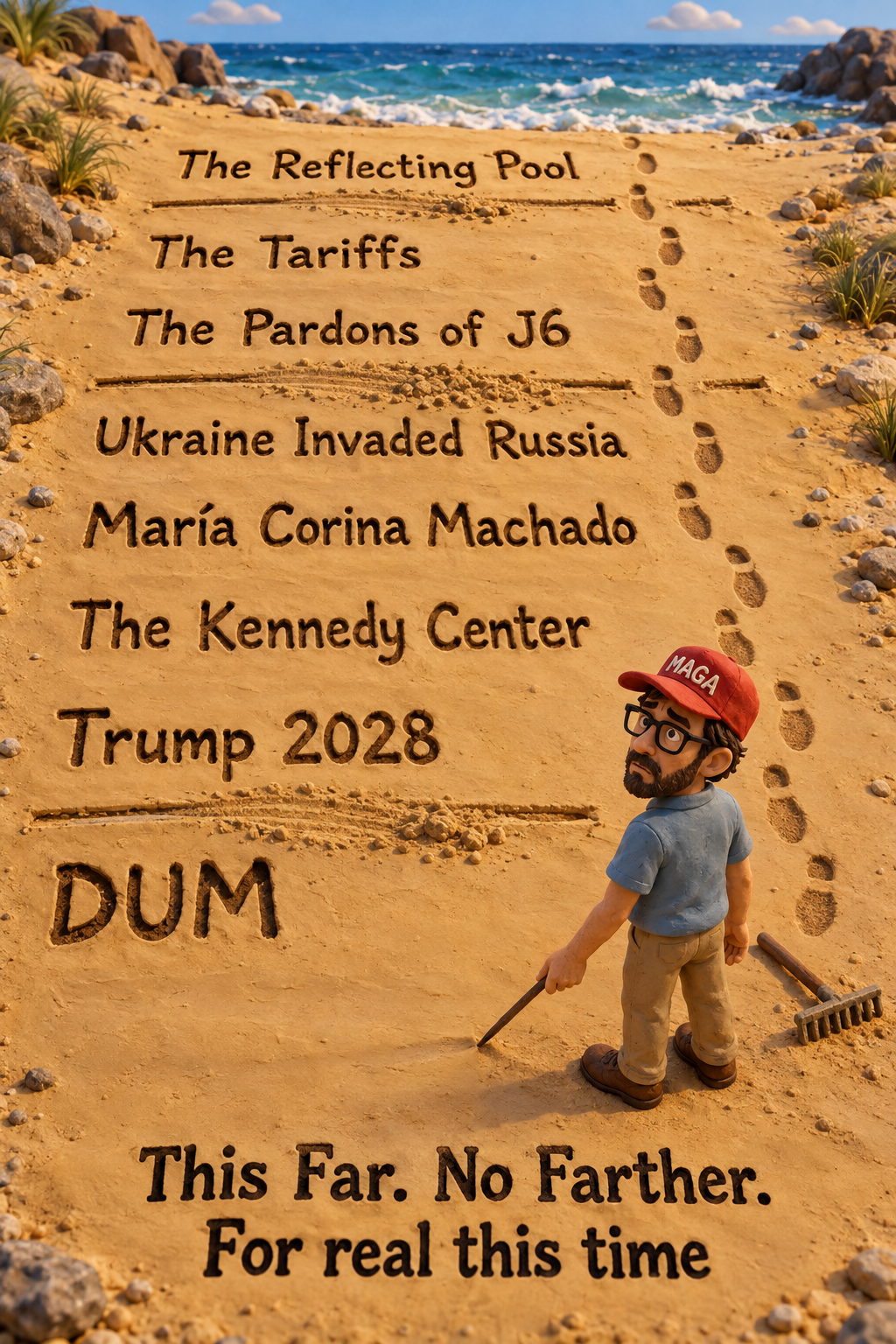
You just have a line you keep moving. I'm just saying.


Comments
Post a Comment