
Make Up a Date, Make Up a Deal
On April 2nd —Trump’s self-declared Liberation Day —he announced tariffs on over 100 countries . According to him, this was to combat trade deficits with nations that were “ripping us off.” But even as he declared economic war on the entire planet , he added a 90-day delay to give countries time to “make deals.” America, he said, was done taking it lying down—this was economic shock and awe.
And sure, 90 days from April 2 is July 2 . But as the deadline approached and the results failed to match the rhetoric, the White House quietly moved the deadline to July 9 . No announcement. No correction. Just a new date—as if 90 days = 97 days , and math was optional.
Then, on Monday, July 8 —one day before that stealth extension expired—Trump signed another executive order, pushing the deadline to August 1 . This was framed as the final, tough-guy moment. The foot is down. The line is drawn.
And then, by Tuesday , he was already rewriting history:
“There’s no change. It’s always been August 1. That’s what we’ve said from the beginning.”
So once again, the goalpost moves , and we’re expected to pretend the football field was never 100 yards long. It’s 100 meters now. And it’s always been 100 meters.
But it wasn’t just the deadline that shifted.
That same executive order also issued tariff warning letters to 14+ countries —including Japan, South Korea, Brazil, South Africa, and Thailand—detailing tariffs ranging from 25% to 50% , and up to 200% on pharmaceuticals , all scheduled to hit August 1 unless new deals are finalized.
Which begs some obvious questions:- What happened to the rest of the 100+ countries Trump threatened on April 2?
- Are they off the hook?
- Are the penguins on Heard & McDonald Islands no longer expected to pay their share?
- And why isn’t a single person in the White House press corps asking about it?
But here's the thing: none of this matters .
If nobody makes any deals and Trump cancels the entire so-called Independence Day Accord , the economic outlook probably improves.
Because world trade was doing just fine on April 1 .
It was April 2 when things changed—when America became the problem .
Not because we had to.
But because the President of the United States believes we can get rich by charging foreign countries a tax to sell us things.
That’s not how trade works.
That’s not how any of this works.
Who Actually Pays?
Let’s break it down.
- Midland Tools buys widgets from Shenzhen WidgetWorks for $1 .
- They sell those widgets to American consumers for $2 .
- Trump imposes a 100% tariff on Chinese goods.
- Midland Tools now pays $1 + $1 tariff = $2 .
- To keep their profit margin, they have to raise the price to $3 .
Trump’s magical thinking?
He claims the exporter will just “cut their price in half.”
- Shenzhen WidgetWorks drops the price to $0.50 .
- Midland Tools pays $0.50 + $0.50 tariff = $1 .
- Consumer still pays $2 , profit margins preserved.
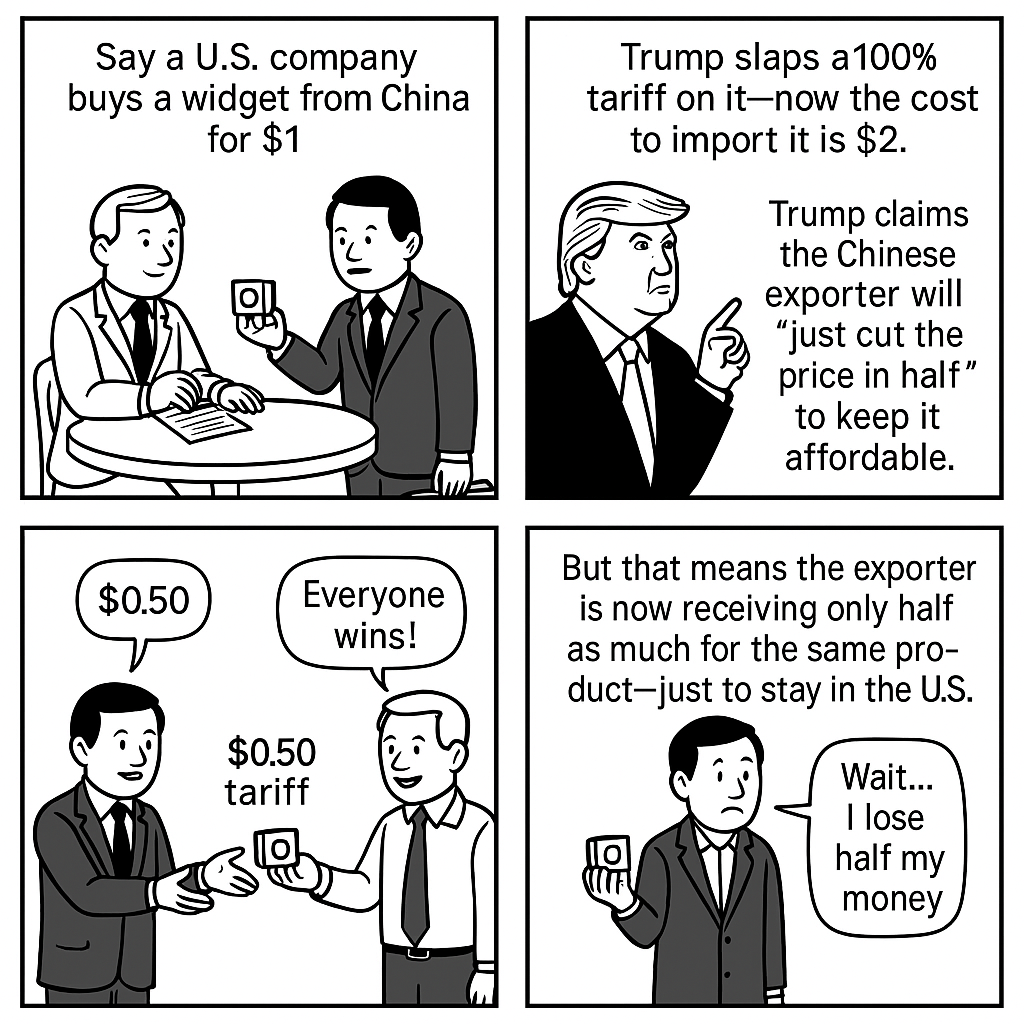
Everybody wins?
No.
Because in that scenario, the Chinese exporter loses half their revenue —and probably all their profit .
Why would they agree to that?
Trump’s answer? Some blend of:
- Vague patriotism
- American exceptionalism
- “Because I said so”
None of that makes economic sense.
The Bottom Line
We buy from China because it's efficient —because labor is cheap, production is massive, and the supply chain runs on scale and cost control.
You can’t just make it cheaper by executive order.
You can’t just Make it cheaper because Donald Trump repeatedly skipped Civics class
Trump may move deadlines, goalposts, and maps with a Sharpie— but he can’t rewrite how tariffs work .
I'm just saying.


Comments
Post a Comment