
From Fake Office to Real-World Incoherence
In the final years of Fred Trump’s life, when dementia had robbed him of the ability to oversee his business, those around him reportedly built a fake office on his property and escorted him there each day, allowing him to go through the motions of conducting business while, in truth, he was being managed through a comforting illusion.
Somewhere near the front end of that decline, Fred sent an aide to Trump Castle in Atlantic City, where roughly $3.5 million in chips were purchased in a transaction that helped rescue Donald Trump’s casino from immediate collapse. While the image of an aide leaving with a briefcase full of chips is sometimes disputed, the essential facts are not: the chips were never used for gambling, and New Jersey regulators later treated the transaction as improper financial assistance to the casino.
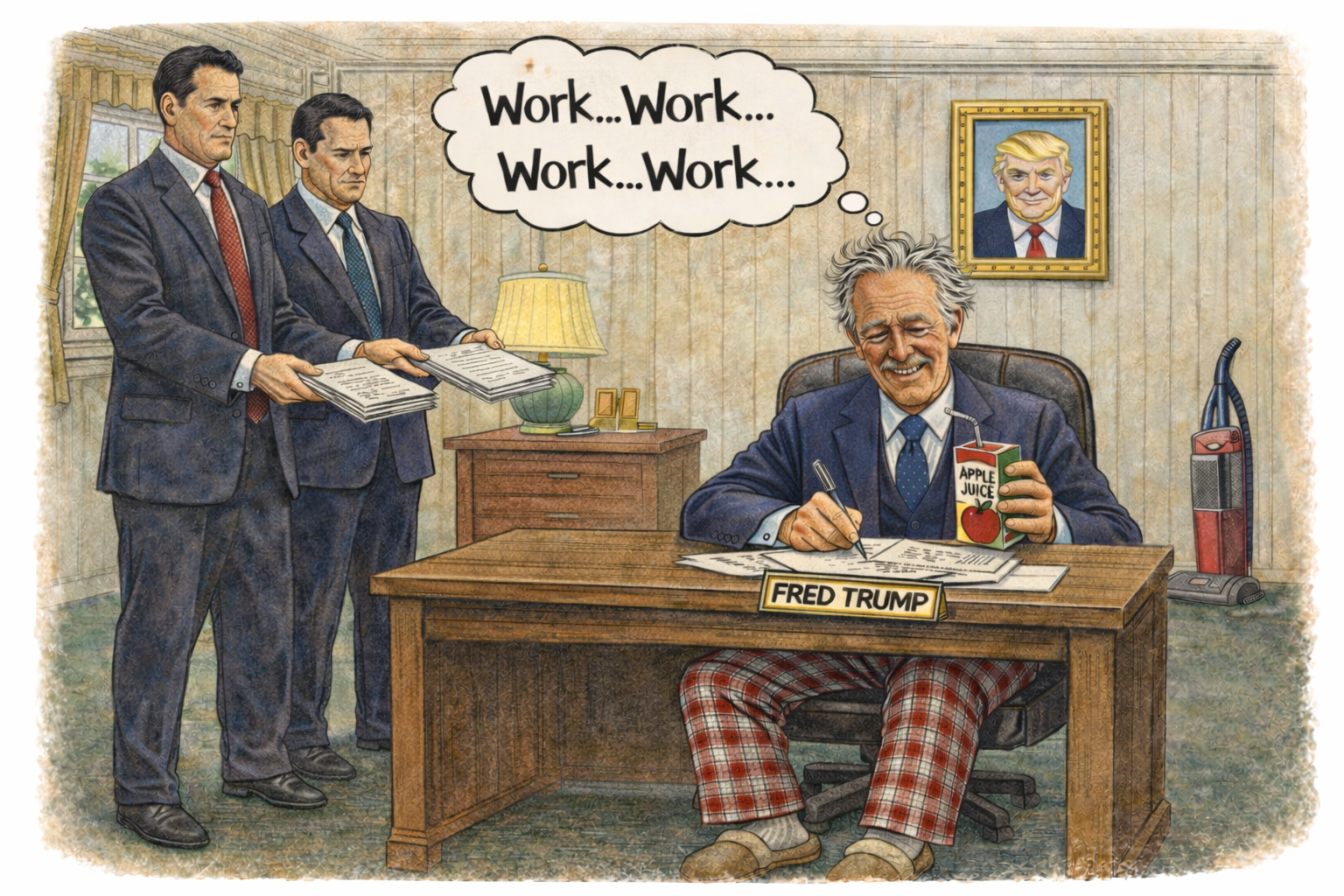
Fred Trump appears to have spent his final years moving from helping rescue Donald’s flailing cash cow to being staged as if he were still presiding over the empire he had assembled. The chip bailout of Donald’s casino in late 1990 is documented; the later fake-office story is not as firmly established. But together they reveal the same pattern of exploitation: first, his money and stature were used to keep Donald’s failing operation on life support, and later, when dementia had hollowed out the man himself, simply invoking the name Fred Trump still carried weight in certain circles. In both phases, what mattered was not Fred’s agency but his usefulness.
Obama’s BlackBerry and the Rules of Reality
When Barack Obama ran for president in 2008, part of his image as a modern politician was his attachment to his BlackBerry. After he won, security officials told him it would have to go, citing hacking risks and the legal requirement to preserve presidential communications.
Obama pushed back for weeks. In the end, he was allowed to keep a specially secured version of the device, with heavy limits on how he could use it. His circle of direct contacts was kept extremely small. Obama later said only about ten people had his personal email address.
No one could reasonably claim the concern was irrational. A president carrying a personal device presents obvious security problems: messages can be intercepted, communications can reveal patterns of movement and association, and even casual exchanges can create intelligence vulnerabilities or records-management liabilities.
That was the real issue, not that Obama loved his BlackBerry, but that once he became president, even a thumb-typed message was no longer just a thumb-typed message.
Trump Learns to Perform the Presidency
When Donald Trump hosted The Celebrity Apprentice, NBC spent years and millions of dollars laundering his image into something that everyday Americans might admire. Somewhere in the middle of that makeover, Trump learned to tweet.
By the time he ran for president in 2016, it was clear that Twitter had become his greatest political asset: a machine for bypassing scrutiny, dominating attention, and turning impulse into power.
It did not.
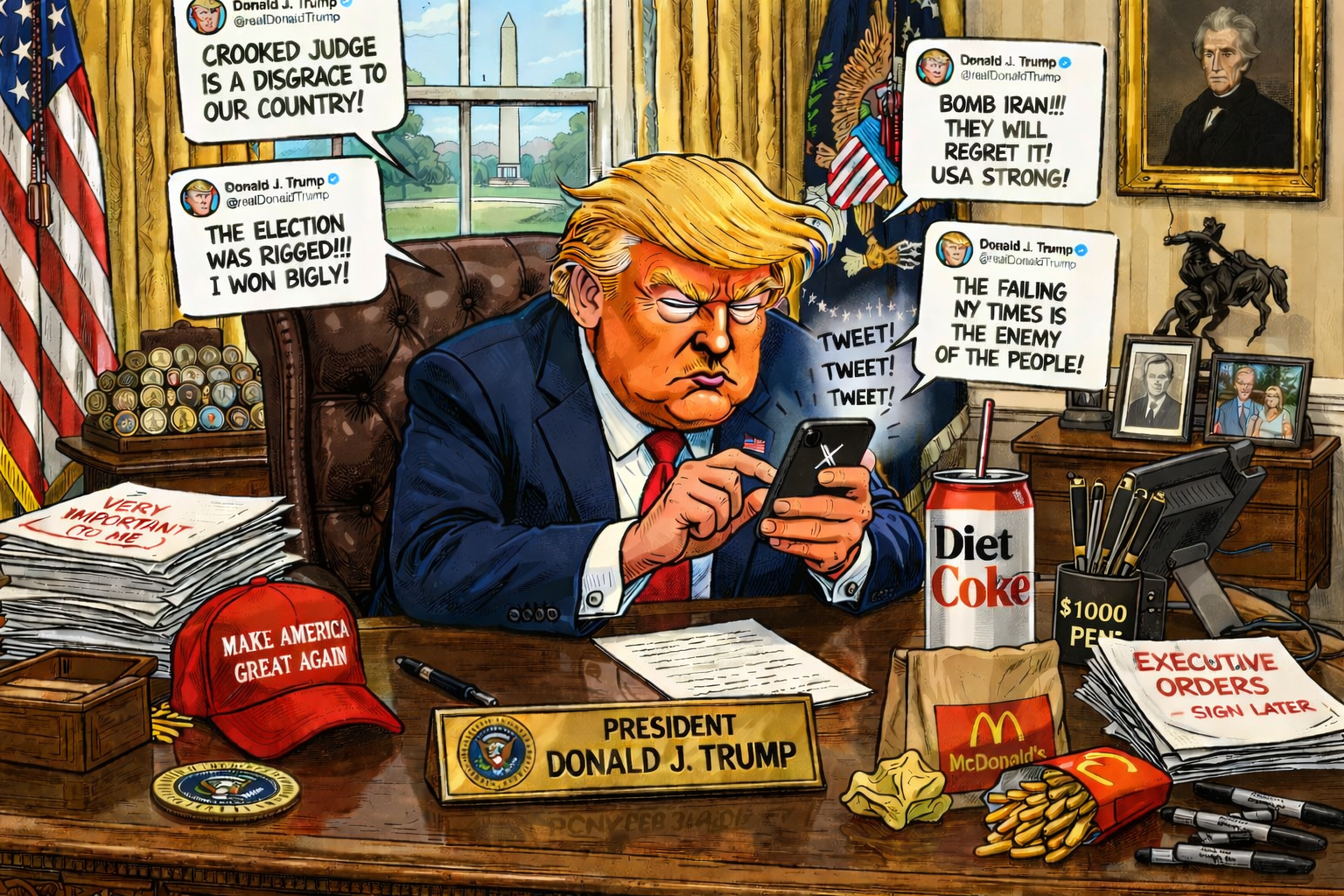
Instead, the people around Trump seemed to recognize that he viewed Twitter not merely as a communications tool, but as a way to perform the presidency itself. He appeared to believe he could announce policy, reshape reality, and govern by impulse in 280 characters or less. The platform did not simply amplify his habits, it rewarded them.
In that sense, Twitter became Donald Trump’s fake office: a place where he could go through the motions of command, mistaking performance for leadership, while the real work of governing was left to others, or simply left undone. It offered the optics of control without requiring the discipline that actual governance imposes.
From Twitter to Truth Social to X
But that was the first Trump administration.
After Trump was finally banned from Twitter in 2020, the fake office briefly went dark. The device was gone. The stage was shuttered. The illusion lost its favorite set.
So Trump did what smaller men with collapsing spotlights do:
He built a cheap imitation.
Truth Social was the folding-chair version of the presidency, and since it was his platform, no one was in a position to restrain his racist rantings or his crass, trailer-park theatrics.
It became a place where he could still rage, posture, issue declarations, and pretend the world was hanging on his every outburst, even as the audience shrank and the walls closed in.
But Truth Social was never enough.
A fake office is only satisfying if enough people agree to walk past it and treat it like the real thing.
Then his friend, and soon-to-be benefactor, Elon Musk bought Twitter, rebranded it as X, installed a Nazi-flavored AI called Grok, and welcomed Trump back with open arms.
And just like that, the fake office reopened.
Only now it was bigger, uglier, and even less tethered to reality.
The same basic pathology remained: a platform built for attention was once again treated as an instrument of governance. A place designed for impulse, trolling, grievance, and spectacle became, in Trump’s mind, a command center, not a medium for leadership, but a substitute for it.
Fred’s Illusion and Donald’s Business Model
Fred Trump, in his final decline, was reportedly escorted into a staged office so he could perform the rituals of business long after control had slipped away.
Donald Trump, with the encouragement of flatterers, fixers, and freeloaders, turned social media into his own version of the same thing: a place where he could sit, issue pronouncements, feel powerful, and mistake reaction for results.
Fred was given the illusion as a kindness.
Donald seized the illusion as a business model, a political strategy, and eventually a governing philosophy. What was merciful in one case became malignant in the other.
That is what made Twitter, and now X, so dangerous in his hands.
It did not merely give him a microphone.
It gave him a fake office from which he could cosplay command, bypass discipline, and confuse performance with power.
And unlike Fred Trump’s mock office, this one came with a nuclear arsenal, a federal bureaucracy, and a press corps still pretending the man at the desk was doing the job.
Trump 2.0: Government by Post
In Trump 2.0, the performance doesn’t even bother to hide itself.
Trump declares policy by post.
Fires people by post.
Threatens rivals by post.
Bullies allies by post.
Menaces judges by post.
Jerks markets around by post.
Scares foreign governments by post.
Then revises reality by post once the backlash lands.
He uses social media to conduct loyalty purges, announce vendettas, trial-balloon abuses of power, and convert personal grievance into public policy. The feed becomes the filter through which state power is announced, tested, and abused.
The point is not governance.
The point is performance,
to make rage look like strength,
impulse look like decisiveness,
and spectacle look like leadership.
Everyone around him is then forced to treat the latest digital tantrum as if it were statecraft instead of what it really is:
A man hunched over his fake office, pounding out threats and calling it governing.
That is not how a constitutional government is supposed to function.
The fake office isn’t a metaphor anymore.
It’s the job.
I’m just saying.


Comments
Post a Comment