
Sounds Reasonable. Isn’t.
Sounds reasonable: “Deport the criminals.”
No, it’s not that simple.
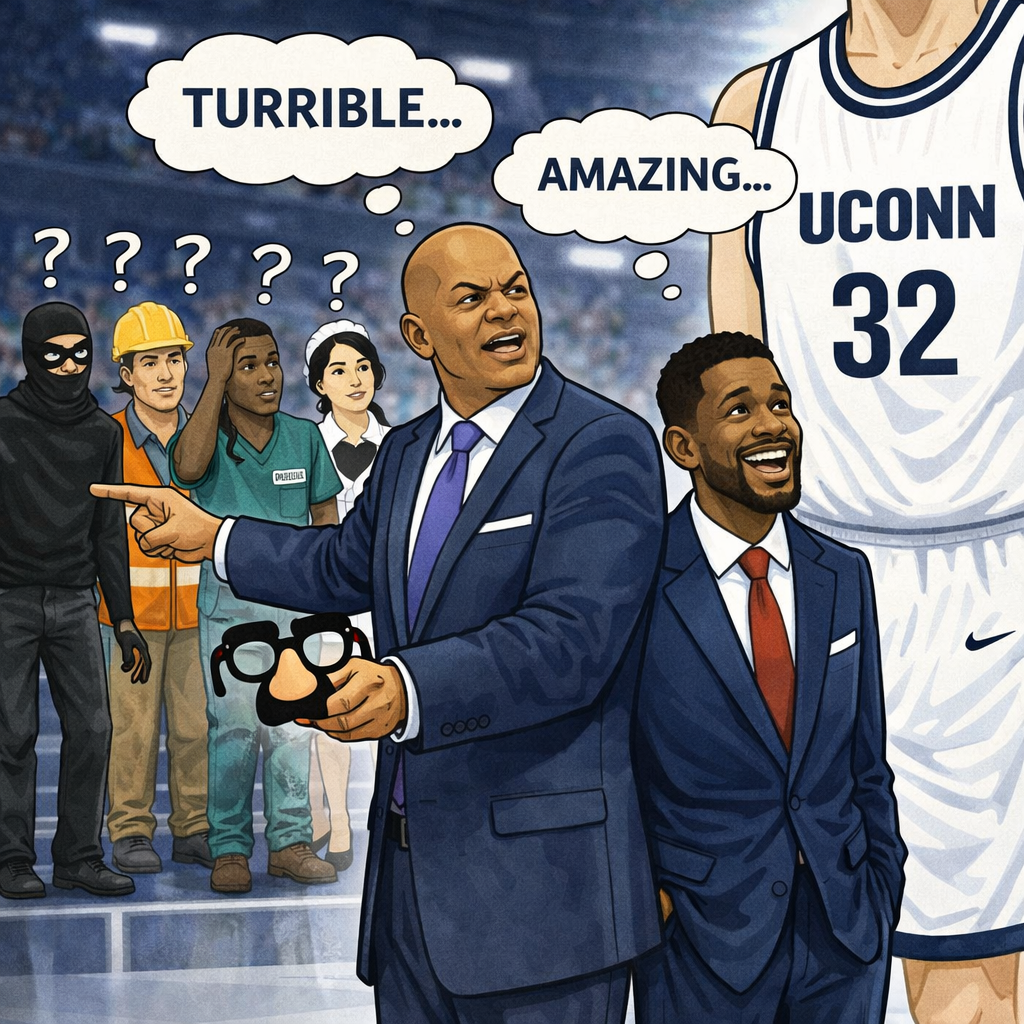
I’ll give Charles Barkley this much: he tried.
During a March Madness broadcast, he was reacting to a segment about Alex Karaban and his immigrant family, and he was moved to push back on some of the uglier anti-immigrant rhetoric being promoted by the Trump administration and, unfortunately, embraced by plenty of people in this country. For Barkley, that’s actually a decent swing.
But he unfortunately stepped into the same trap everyone else seems to these days.
He said there’s a difference between “amazing immigrants” and “criminal immigrants.”
And there you have it.
Right there, that framing doesn’t just divide people into two categories, it quietly sets the default. It establishes the starting assumption before any evidence is even considered. It doesn’t land as “most immigrants are fine, some are criminals.” It lands as “immigrants are a problem, except for the especially admirable ones.”
Suspicion becomes the baseline.
The compliment doesn’t fix the stereotype. It enforces it. It validates the premise it pretends to soften.
And worse, there’s no middle ground. No room for ordinary people. No room for the guys outside Home Depot looking for day work, or for the woman cleaning homes and offices, or for the family just trying to get by. If you're not “amazing,” you’re invisible.
I’m sick of people saying things like, “Most people support deporting the criminals,” as if that’s some kind of reasonable middle ground.
It is not.
It’s bigotry and hatred wearing Groucho glasses. A disguise that only works if no one looks too closely. The whole thing leans on the quiet part: the assumption that undocumented immigrants are criminals first and people second.
They aren’t.
In states like Texas, one of the few places that actually tracks this, undocumented immigrants are arrested at significantly lower rates than native-born Americans. That makes perfect sense. People who don’t have legal status do not want to draw attention to themselves. They are not looking to have a chat with local police, the courts, or ICE. They tend to avoid the kind of behavior that puts a spotlight on them. It’s just too risky; the ends don’t justify the means.
Does that mean none of them commit crimes? Of course not. There are criminals in every group. But there are far more criminals who were born right here in the United States. So the assumption that undocumented criminals are somehow worse, or more dangerous, or more worthy of national obsession is ridiculous on its face. It’s not evidence-based, it’s narrative-driven.
And while we’re bullshitting, let’s look at the SAVE Act circus.
That’s the same trick in a different outfit, maybe a trench coat and a floppy hat pulled down low.
Noncitizen voting is already illegal. In every county in the U.S. (and yes, counties administer elections), you must first register to vote before you can vote. To register, you have to present ID. The confusion, and the point that gets exploited, is that in some places, though not most, noncitizens can vote in school board or community elections. That’s not ridiculous because, whether documented or not, they contribute to the community in which they live. Their children go to school there. They most likely pay taxes there, sales tax if nothing else. In absolutely no jurisdiction are undocumented immigrants allowed to vote in federal elections.
Investigations into voter fraud repeatedly find that noncitizen voting is vanishingly rare. And because somebody will still try to play games with that phrase, let’s spell it out: “rare” means you might run into it once in a blue moon. “Very rare” means you probably won’t. “Vanishingly rare” means you can go looking for it and still find almost nothing. It’s so scarce it barely registers statistically. In other words, the math falls apart long before the fearmongering does.
The bill, therefore, does not solve some widespread crisis. It creates a paperwork barrier that complicates the structure. Plenty of eligible Americans do not have easy access to their birth certificate, and passports cost money. As of 2025, there were roughly 170 million valid U.S. passports in circulation compared to a population of about 342 million. So, if you do the math, carry the 1, roughly half the country has a passport, or more importantly, half of all Americans do not have a passport.
The don’t-haves get told to go searching through bureau drawers, attics, and places unknown to find ancillary documentation just to prove they belong here. The burden shifts from the state proving fraud to the citizen proving legitimacy. I am somebody.
For millions of Americans, proving citizenship isn’t a quick ID check, it’s a paperwork hunt that costs time and money.
And if you’re a married woman, there’s a decent chance your birth certificate doesn’t even match your current name, so now you’re not just proving citizenship, you’re proving your own identity across decades of paperwork.
The SAVE Act does not make that problem disappear. It bakes it in. It formalizes the friction as a feature, not a flaw.
So again, this adds a layer of bureaucratic nonsense written right into the premise of the law.
Start with a tiny or imaginary problem, slap “security” on it, and build a system that treats people like suspects. The solution expands while the problem barely exists.
Same playbook. Different target.
And to be clear, I’m not picking on Charles Barkley. He’s an athlete, an amazing one, not a wordsmith. He was trying to push back on something ugly, and in his own way, he did.
But that’s exactly why this matters.
Because even when someone is trying to say something good, the language they reach for still carries the same backhanded assumptions. The bias survives even inside the attempted correction.
I just don’t want to see this turn into a thousand Facebook and Instagram posts quoting “amazing immigrants” like it’s some kind of enlightened take, racking up goo-gobs of likes while quietly reinforcing the same old stereotype.
Because that phrase doesn’t fix the problem.
It repackages and repurposes it.
It still starts from the idea that immigrants are suspect, and then hands out praise to the ones who rise above it. Approval becomes conditional instead of assumed.
That’s not a defense.
That’s just a softer version of the same bias.
And I’m not interested in polishing prejudice until it sounds polite.


Comments
Post a Comment