
Great for Who?
When people say “make America great again,” the real question is: great for who? Because there were long stretches of American history when things were “great” only if you were in the right group, and not so great if you weren’t.
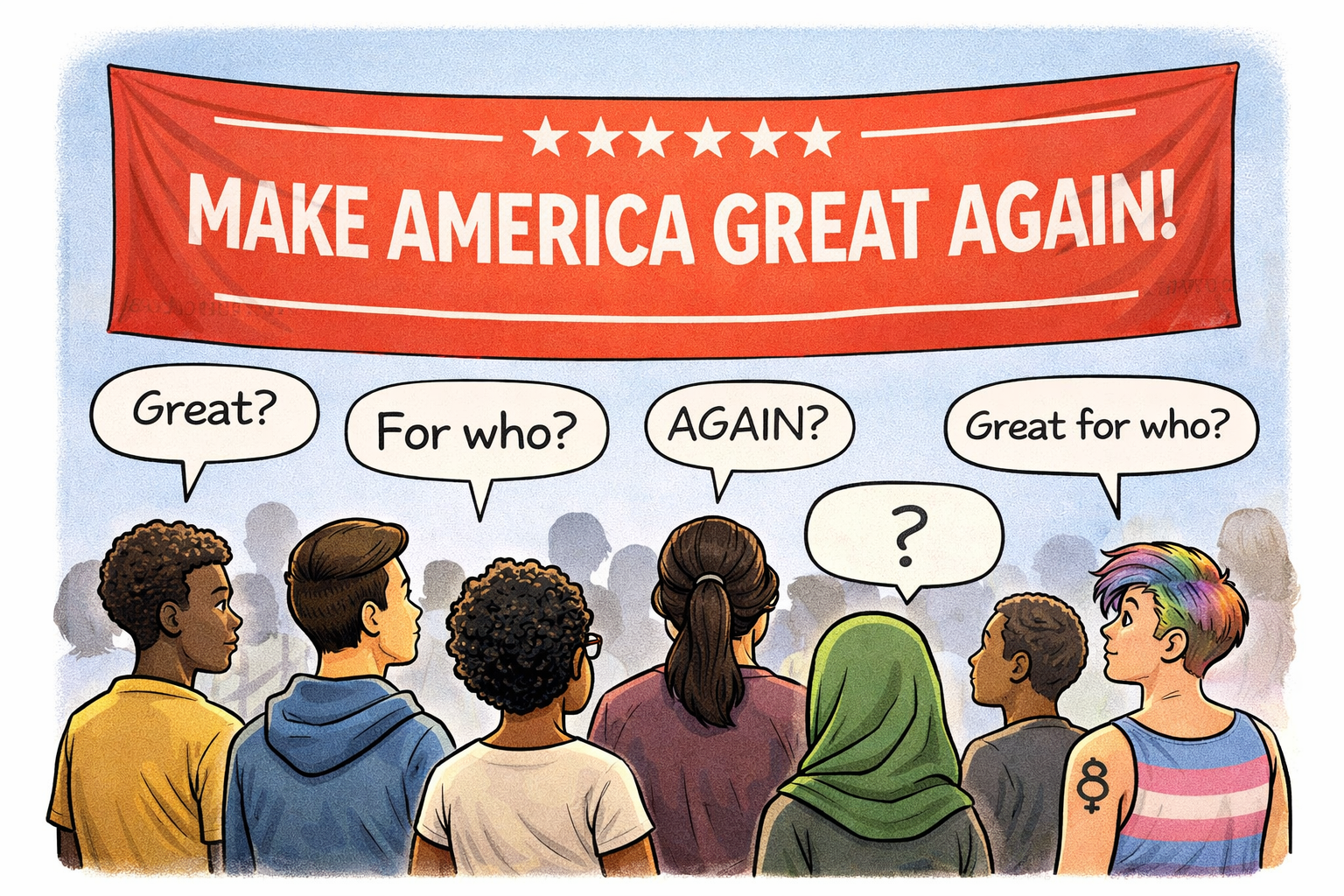
Now let’s talk about that “again.”
I gave eight years of my adult life in service to God and country. Voluntarily. No draft. No pressure. I stepped away from my place in the workforce, took up arms, and chose to serve.
You don’t do that for a country you think is worthless.
You do that because you believe it is worth defending.
And not some gussied-up, paint-by-numbers fairy-tale version of America, either.
I’m talking about the real America, the complicated America. The one that began with soaring language about liberty and equality while denying both to huge numbers of people. The one that had to be dragged, inch by inch, toward its own ideals by people who refused to accept less.
Because America did not accidentally fall short of its promises. It was built with contradiction baked in from the start.
This nation claimed Native land by treaty, trade, theft, coercion, and, once it proved faster, by force. Native people were pushed west, pushed aside, and pushed out of the story whenever their existence got in the way of someone else’s ambition.
At the same time, the labor system hardened into something even uglier. Indentured servitude gave way to racial slavery because permanent bondage was more profitable, more controllable, and easier for white society to enforce. A white servant could sometimes run and disappear into the larger population. An enslaved Black person could not. In a society that had turned skin color into legal status, Blackness itself made escape more dangerous, recapture more likely, and freedom easier to withhold.
So let’s stop pretending the exclusion was some unfortunate glitch in the machinery.
It was part of the machinery.
From the Three-Fifths Compromise to Jim Crow, from literacy tests and poll taxes to voter suppression repackaged as “election integrity,” America has always been arguing over who counts fully, and who never was meant to.
And every time this country has moved closer to the answer “everybody,” there has been a backlash from people determined to put the gate back up.
That is why I reject the cheap nostalgia built into “Make America Great Again.”
Because when you point backward in American history, you are pointing toward eras when rights were narrower, hierarchies were harder, and whole categories of people were expected to stay in their place and call it peace.
There were times when America felt orderly, stable, even “great” to a lot of people. Sure. But that kind of greatness is easy to maintain when the comfort of one group depends on the exclusion of another.
That’s not greatness.
That’s obedience to a pecking order taught as virtue.
And I didn’t serve to defend that.
I served because I believed in a different America, the one that keeps widening the circle, not shrinking it.
The America pushed forward by people like Frederick Douglass, who was born into slavery, fought his way into literacy, became one of the greatest orators in American history, whose counsel John Brown sought before Harpers Ferry, and whose relentless pressure helped push Lincoln toward Black enlistment and emancipation during the Civil War. People like Booker T. Washington, who built Tuskegee Institute into a beacon of Black education and self-determination. People like Mary McLeod Bethune, who went from the daughter of formerly enslaved parents to a trusted advisor to Franklin Delano Roosevelt. People like Fannie Lou Hamer, who was “sick and tired of being sick and tired,” and turned that weariness into righteous fire. And people like Dr. Martin Luther King, who gave this nation his dream and gave his life in the struggle to make it real.
That’s the America I believed in.
That’s the America I served.
Not because it was ever perfect. It wasn’t.
Not because it had already fulfilled its promise. It hadn’t.
But because it was still worth fighting for, not as it was at its worst, but as it could be at its best.
So when I hear “great again,” I don’t hear patriotism. I hear selective memory. I hear a longing for a past that worked better for some people because it worked worse for others. I hear nostalgia for a country where freedom came with qualifiers, equality had fine print, and full citizenship depended a little too much on your race, your gender, your religion, or your place in the social order.
That is not the greatness I signed up to defend.
I did not give eight years of my life so this country could crawl backward toward selective freedom, selective dignity, and selective democracy.
I served because I believed in an America that gets bigger in the ways that matter.
More rights.
More access.
More belonging.
More people fully counted.
And as a side note, if you have to limit who can participate in the political franchise in order to claim moral victory, then you didn’t win anything at all. If your “victory” required you to step over the bodies of the very Americans who helped carry you down the field, then it wasn’t a moral triumph. It was betrayal wrapped up in red, white, and blue and packaged as principle.
America is not great when it goes backward.
America is great when it moves closer to justice.
America is great when more people count, not fewer.
America is great when the promise gets bigger.
That’s the country I believed in then, and still believe in to this very day.
I pledge thee my allegiance, America, the bold.
For this is my country to have and to hold.


Comments
Post a Comment