
The Couch-Humping Heir Apparent
 |
I saw it as Vance saying to America:
I am the couch-humping, hateful heir apparent to Donald Trump—hear me bore.
While each of those issues deserves its own article, I’m only going to deal with one: his over-the-top, racist assessment of Jasmine Crockett.
Speaking about Jasmine Crockett, Vance said:
“She wants to be a senator, though her street girl persona is about as real as her nails.”
Let’s break down what he did here.
On its face, the sentence makes two mutually incompatible moves:
- He asserts that a “street girl persona” exists.
- He then declares that it’s fake.
That means Vance introduces the slur himself. He isn’t rebutting someone else’s claim; he’s supplying the frame.
If his intent were genuinely:
“She’s not a caricature; she’s qualified,”
the sentence would have looked like:
“They try to paint her as X, but she’s actually Y.”
He didn’t do that.
Instead, he said:
She presents herself as X, but it’s fake.
That isn’t defense. That’s delegitimization.
And if the interpretation was supposed to be:
“A real street girl is authentic, and she isn’t one,”
that still collapses on inspection, because:
- He chooses “street girl” as the evaluative category.
- He implies authenticity is measured by proximity to that stereotype.
- He then denies her even that supposed authenticity.
So even under the most charitable reading, the structure is this:
She’s pretending to be something people recognize—and she’s not even that.
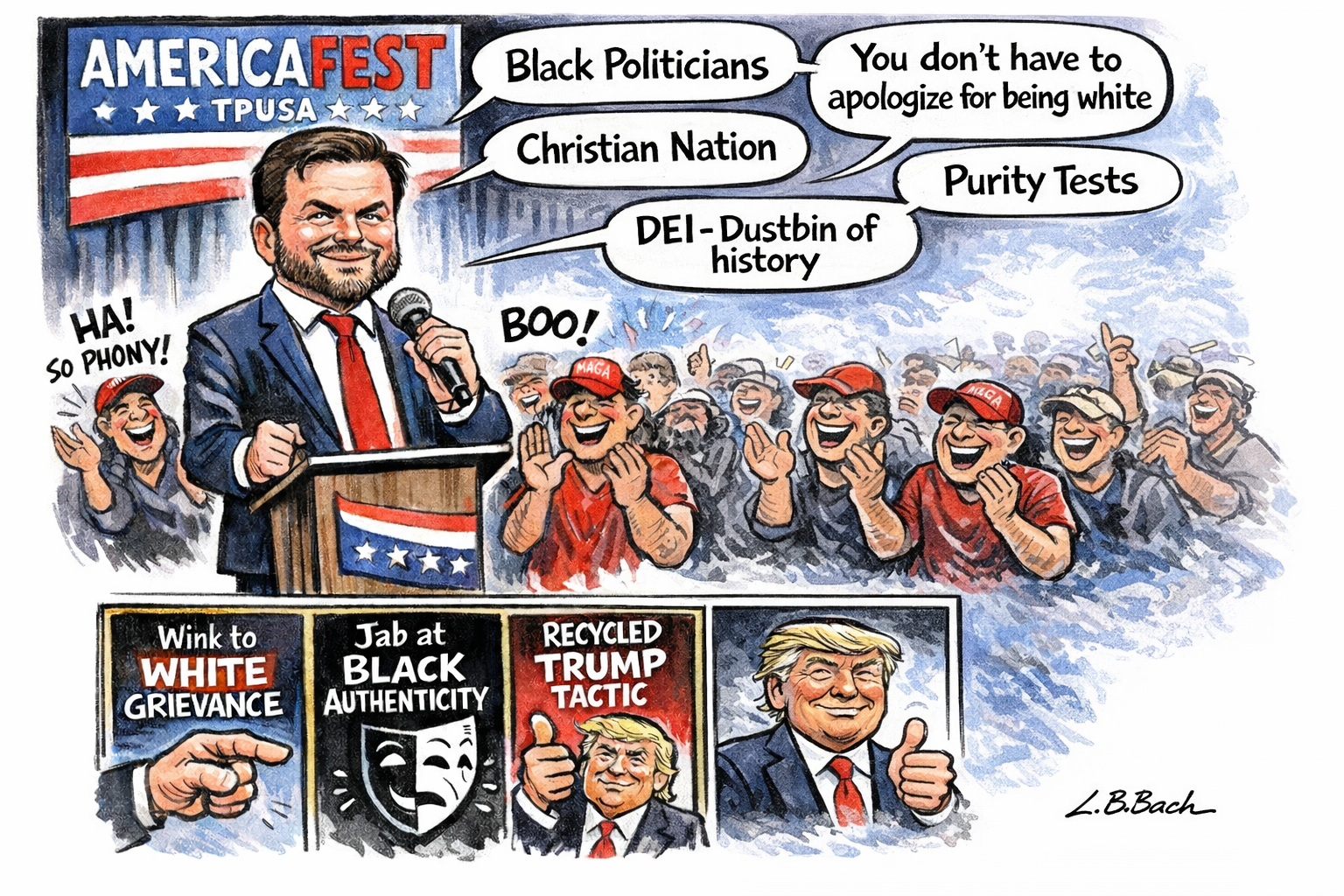
To the AmericaFest crowd, the sentence translates as:
Don’t worry—if you dislike her, you’re right to.
The thing you think
she is?
She’s faking it.
To white MAGA listeners, it signals:
Yes, she’s Black—that kind of Black—and you know exactly what I mean.
The stereotype does the work. He never has to say it out loud. Plausible deniability intact.
To Black listeners, or anyone paying attention, it signals:
She’s not authentically Black. She’s performing it.
That is the same move Trump used against Kamala Harris:
“She didn’t used to be Black.”
Different phrasing. Same playbook.
Summary
- a wink to white grievance,
- a jab at Black authenticity, and
- a recycled Trump tactic dressed up as a joke.
It wasn’t subtle. It wasn’t accidental. And it wasn’t meant to withstand logical scrutiny, only applause.
I’m just saying.


Comments
Post a Comment