
Uncommited
It started on October 7, 2023, when Hamas terrorists launched a brutal attack
on Israel.
The images were horrifying, and the politics immediate. Within hours, online
activists were already less interested in Hamas’s atrocities and more
interested in grading Joe Biden’s reaction.
Biden, having been a statesman for four decades before ascending to the White
House, acted presidentially. He condemned the attack, backed Israel’s right to
defend itself, and tried to contain a regional explosion.
But in the online corners of the left, that wasn’t enough. They accused Biden
of being “complicit.” The outrage, real or feigned, turned into a purity test.
Unfortunately, the 2024 campaign season was starting. Biden had had a
remarkably successful presidency, with no serious challengers. However, many
Democratic primaries offered an alternative option: “Not committed to any
candidate.”
Suddenly, the self-described moral intellectuals — the
smarter-than-the-rest-of-us crowd, angry at Biden for not stopping Netanyahu —
decided that this would be a safe, symbolic way to protest. “Uncommitted”
became the protest brand of choice.
By spring, roughly 900,000 Democrats had used it in primaries to signal
disapproval over Gaza.
That discontent curdled into apathy. When the general election came, roughly three million 2020 Biden voters stayed home. And while bad-faith actors like Joe Rogan, Elon Musk, Candace Owens, and Charlamagne tha God (shouldn’t that more accurately be Charlamagne tha Charlatan?) poured gasoline on the fire, the intellectual disenfranchisement sparked by “Uncommitted” was enough to flip the presidency.
And it cannot be stressed enough: for the first time in recorded history, the mainstream media, party leadership, thirty sitting members of Congress, and a host of right-wing haters collectively convinced a successful sitting president to drop out of the race — because he was “too old.” They somehow ignored the fact that his likely opponent was only two years younger, visibly in cognitive decline, and had spent the previous eight years displaying not a spark of genius. So, some of those who stayed home weren’t apathetic at all — they were furious that the Democratic Party had once again snatched defeat from the jaws of victory. They were furious that the party triggered the ensuing chaos by showing its poker hand and saying, “You may have a shitty hand — but I’m not that confident in mine.”
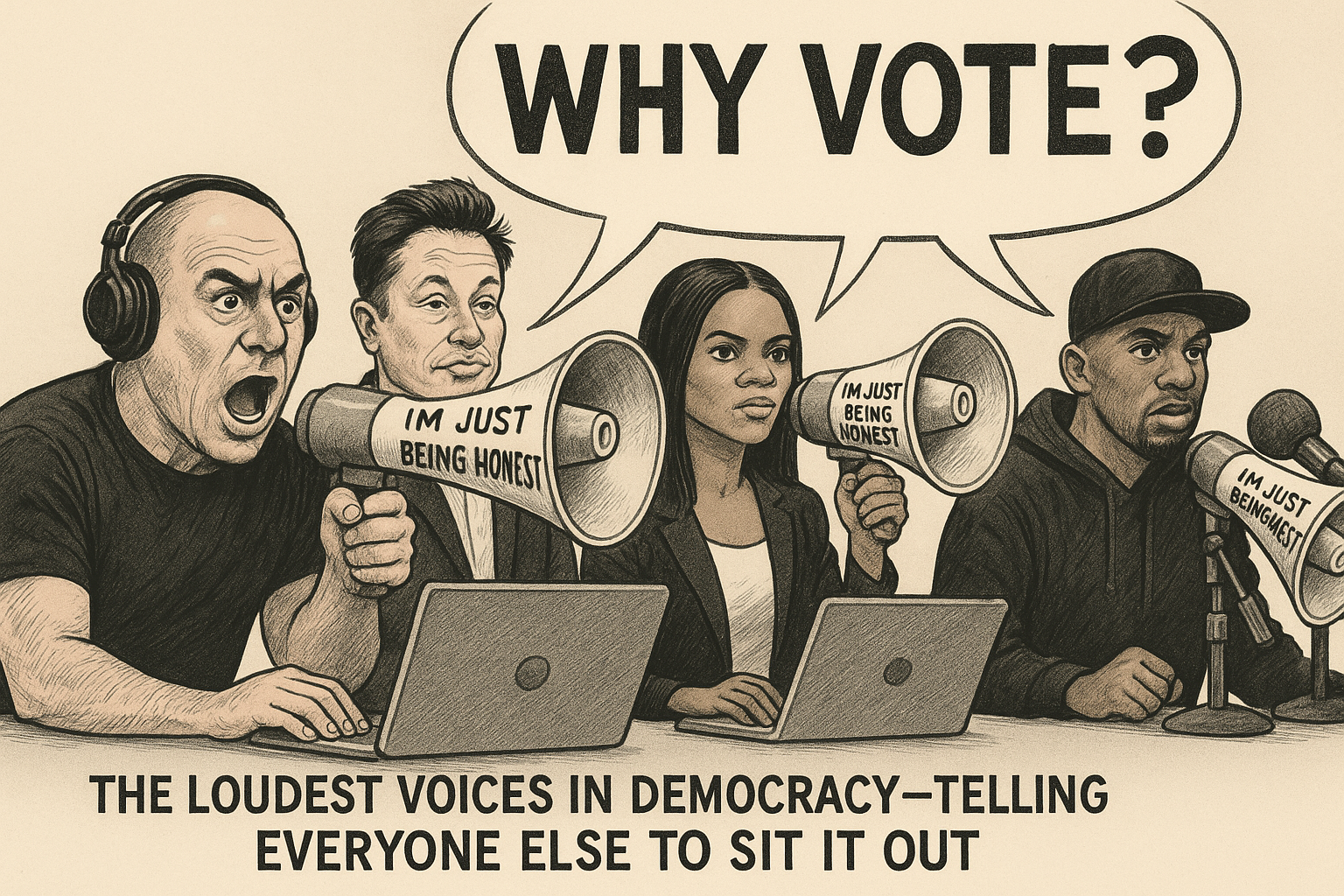
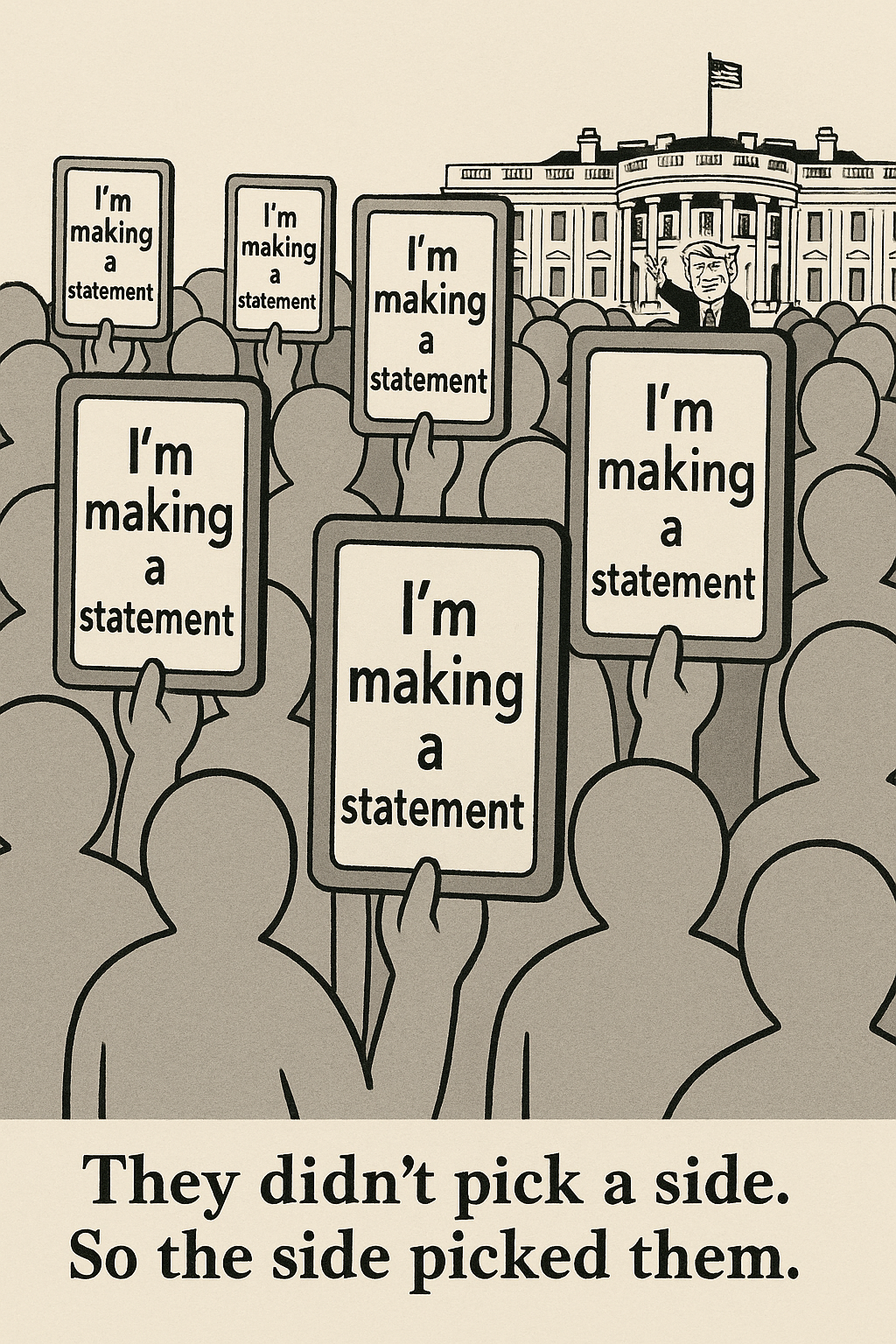
But here’s the thing: Americans, when convinced that doing nothing is somehow the smart or sophisticated thing to do, tend to do exactly that — nothing. Those 900,000 “Uncommitted” voters made up roughly one-third of that missing Democratic turnout. The very people who set out to make a “principled statement” against Biden’s policy helped set the cultural tone for the rest.
National results make the point. Trump received about 77,303,568 votes to
Harris’s 75,019,230 — a margin of roughly 2,284,338.
Roughly three million Biden 2020 voters didn’t show up. One-third, about
900,000, were the self-described “Uncommitted.”
The other two-thirds, about 2.1 million, followed their lead — disillusioned
or convinced that staying home was the higher ground.
If those three million had voted, the story would have changed.
At 85 percent Harris to 10 percent Trump, the net gain would have been about
2.25 million votes — nearly a tie.
At 86 percent, the race becomes a statistical draw.
At 87 percent, Harris wins the popular vote outright.
The Electoral College math tells the same story.
Pennsylvania needed about 120,000 votes, Michigan about 80,000, and Wisconsin
about 29,000 — roughly 230,000 total.
That’s less than eight percent of the missing three million.
Even a modest turnout bump in those three states alone would have produced 270
electoral votes and a Harris presidency.
That’s not opinion; that’s arithmetic.
Joe Biden wasn’t ignoring the cries for restraint. He was walking the same
tightrope every responsible leader walks.
For fifty years, the man had listened, negotiated, and built coalitions.
He understood what too many Hashtag Statesmen and Keyboard Diplomats didn’t:
you don’t bully your allies.
You pressure them, you argue, you apply leverage, but you don’t blow up the
relationship in the middle of a war.
That’s not moral weakness; that’s foreign policy conducted by adults.
Israel has long been a U.S. ally, practically a protectorate.
Biden wasn’t endorsing genocide; he was trying to prevent a regional one.
But nuance doesn’t trend on social media, and diplomacy doesn’t fit on a
protest sign.
The Gaza protest vote was supposed to teach Democrats a lesson.
Instead, it taught Republicans how powerful moral exhaustion can be.
Once “Uncommitted” became fashionable, inaction became virtue.
The Hashtag Statesmen told their circles, “Withholding your vote sends a
message.”
And it did — just not the one they thought.
Apathy spreads faster than conviction. When doing nothing feels righteous,
everyone suddenly becomes a conscientious objector.
We didn’t get beaten by extremists; we got tranquilized by our own
self-importance.
A protest only makes sense if the alternative is better.
But does anyone seriously believe Donald Trump would take a firmer moral stand
in Gaza?
Trump proved in his first term that he wouldn’t stand up to Netanyahu — and
that, frankly, he didn’t care about foreign policy at all.
I doubt the man can even spell “Palestinian.”
Those idealists didn’t empower diplomacy; they enabled its opposite.
They didn’t move the needle; they bent it backward.
So yes, apathy elected Trump.
Not the MAGA faithful, not some unstoppable conservative wave, but millions of
disenchanted Democrats who decided that silence was sophistication.
If you want to protest, do it. Protest loudly. Vote fiercely. Organize
relentlessly.
But never again confuse withdrawal with wisdom, or silence with virtue.
Because in 2024, one-third of the “principled” became the seed of apathy — and
the smartest people in the room handed the keys to the dumbest one standing.
I'm just saying.


Comments
Post a Comment