
The Polite Language of Political Exclusion
I’m so happy that Bill O’Reilly and the rest of the pearl-clutching panic caucus told us in 2008 that Obama winning meant America was now post-racial.

Now, nearly 20 years later, people still won’t vote for a Black woman for president, even when she runs intellectually unopposed. In Texas, Democrats still can’t get behind a Black woman for Senate. And once again, we hear that tired little word: unelectable.
But wait—Obama was supposedly unelectable too. And then he got elected. Twice, which should’ve killed the argument if the argument were ever honest.
So maybe unelectable doesn’t mean can’t win. Maybe it means this makes certain people uncomfortable.
Uncomfortable with Black ambition.
Uncomfortable with Black authority.
Uncomfortable with a Black woman who doesn’t ask permission to be taken seriously.
That’s the trick of the word unelectable: it takes bias, anxiety, and social fear, then launders them into something that sounds strategic, as if prejudice becomes “analysis” the moment you say it calmly.
And let's not forget, in 2008, Hillary Clinton took that unelectability ball and ran with it: “Working, hard-working Americans, white Americans,” as if “white” was the qualifier that mattered. That’s the whole unelectable scam—prejudice laundered into prudence, then sold back to us as wisdom.
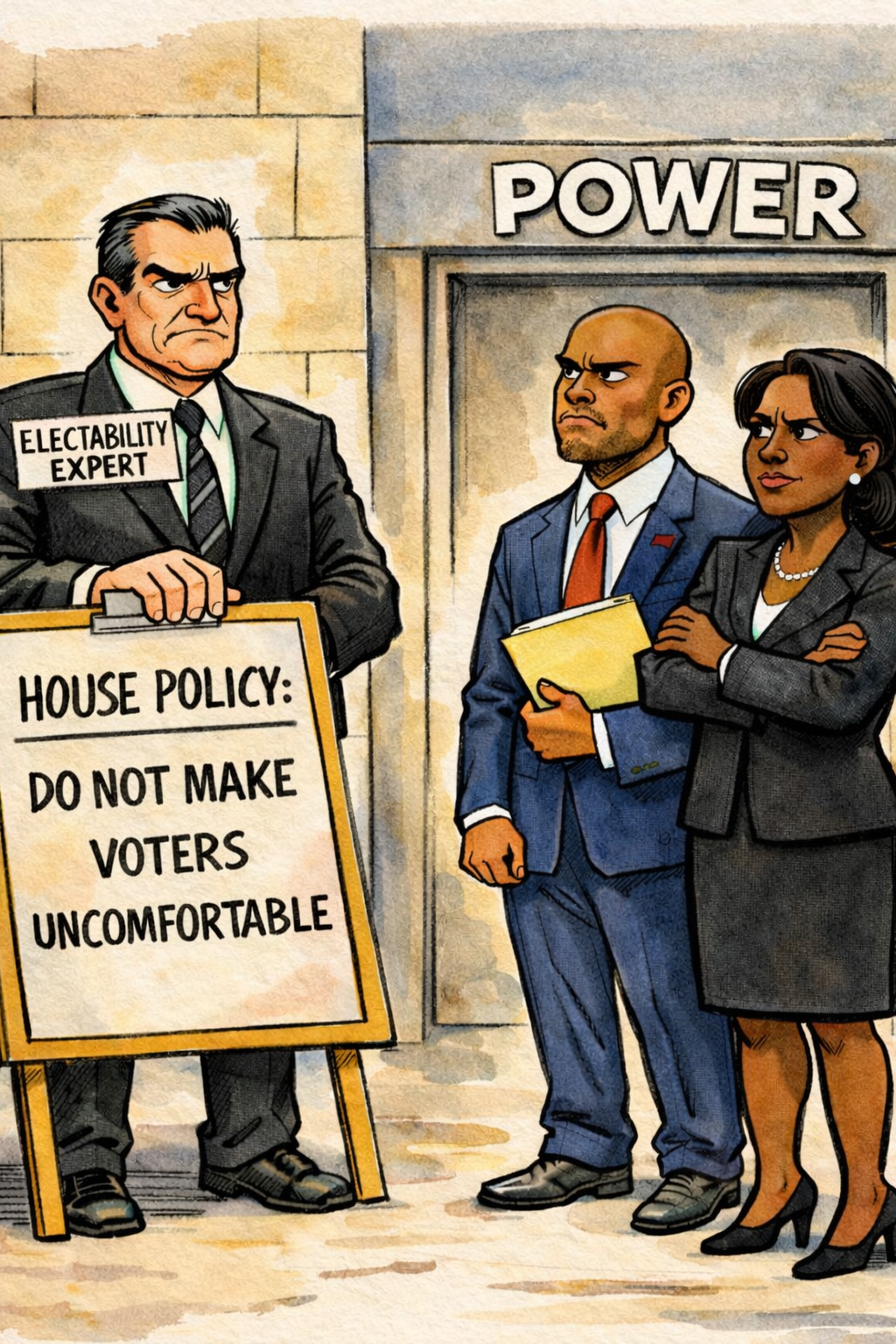
And that’s the scam. Unelectable doesn’t always mean can’t win. A lot of the time, it means I’ve already baked other people’s prejudice into the math—and then congratulated myself for calling it “realistic.”
It means I assume the country—or my neighbors, or my party, or my group chat—won’t fully see this person as presidential, senatorial, or worthy of power. So we dress it up as pragmatism. We call it strategy. We call it realism because “realism” sounds better than “I don’t want the fight.”
But a lot of what gets called “electability” is just comfort, convenience, and cowardice, repackaged so nobody has to say it out loud.
When people say a Black candidate is “unelectable,” what they often mean is: I’d like credit for being evolved enough to recognize this person’s qualifications—but not so evolved that I’m willing to confront the people who bristle at Black authority.
Comments
Post a Comment