
John Roberts Is a Terrible Chief Justice—and a Terrible, Terrible Man
John Roberts, despite his obvious concern for his legacy, will be remembered as one of the worst chief justices in American history, which is quite an achievement considering that he followed William Rehnquist.
During his confirmation hearings, Roberts sold himself as a modest judge who respected stare decisis. He warned that overturning precedent delivered “a jolt to the legal system” and compared judges to umpires who merely call balls and strikes.
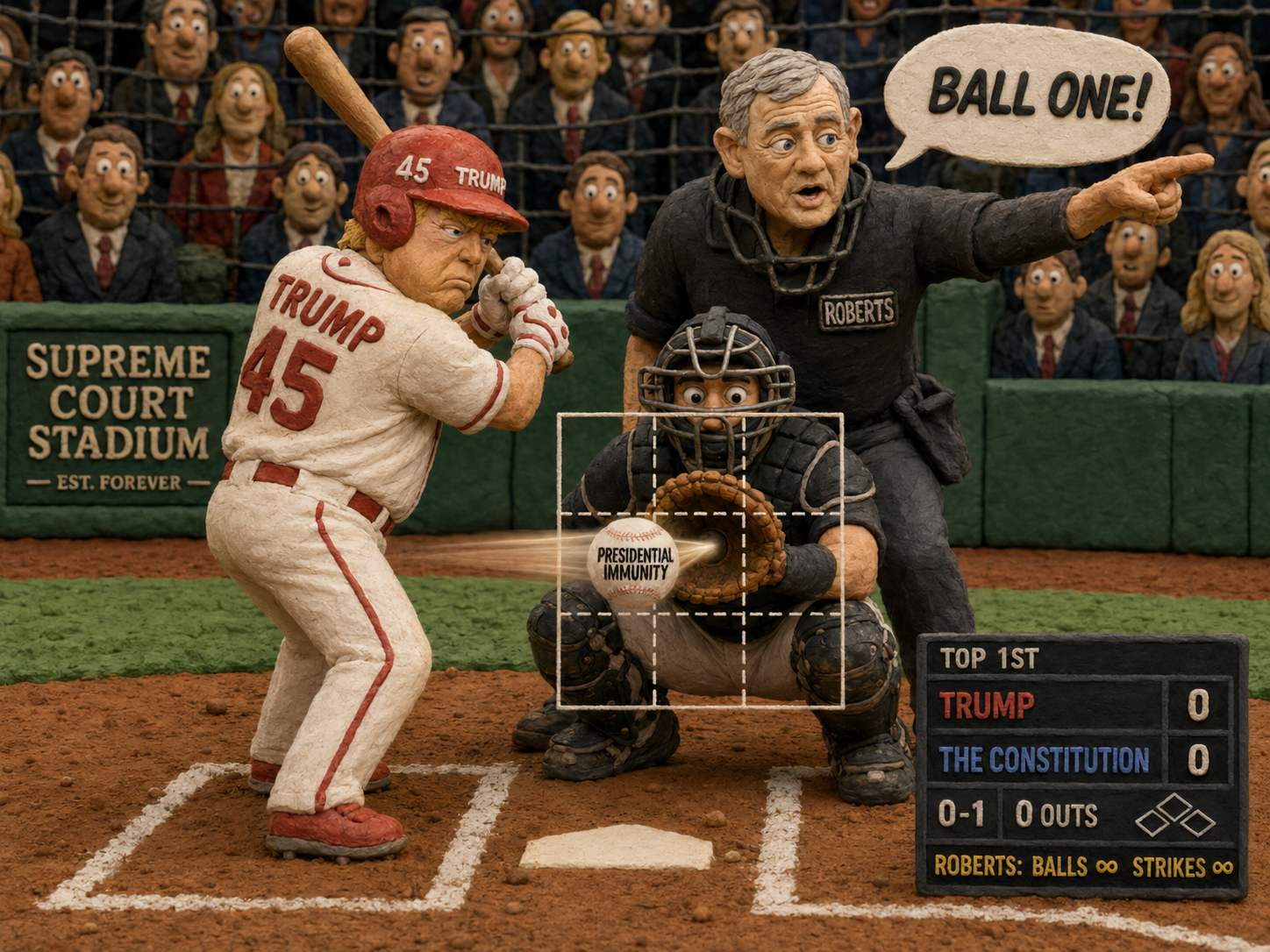
Then he got the job.
One of the clearest early demonstrations of the fraud was Citizens United.
The case was heard twice.
After the first argument, the Court could have resolved the narrow dispute before it. Instead, Roberts’s Court ordered the case reargued and specifically directed the parties to address whether major campaign-finance precedents should be overturned. The case was argued in March 2009, set for reargument in June, and heard again in September.
The precedents were overturned.
Apparently, a “jolt to the legal system” was unacceptable until Roberts found a precedent obstructing the Republican political project.
The highlights of his record are almost a checklist of damage:
- He helped open American elections to virtually unlimited corporate political spending.
- He wrote the decision gutting the Voting Rights Act’s preclearance system.
- He wrote that extreme partisan gerrymandering was beyond the reach of federal courts.
- He upheld Trump’s travel ban despite Trump’s extensive record of anti-Muslim statements.
- He wrote the decision ending race-conscious admissions at Harvard and the University of North Carolina.
- He restricted the Environmental Protection Agency’s ability to address carbon emissions.
- He overturned the 40-year-old Chevron precedent, transferring enormous authority from federal agencies and subject-matter experts to federal judges.
- He presided over the Court that overturned Roe v. Wade. Roberts preferred to destroy it more gradually than the other conservatives, but destruction was still the destination.
Then came presidential immunity.
Roberts wrote the decision granting a former president absolute criminal immunity for actions within his exclusive constitutional authority and at least presumptive immunity for other official acts. No previous Supreme Court had created such broad criminal immunity for presidents.
The SEAL Team Six hypothetical was first raised during oral arguments in the lower court: Could a president order the military to assassinate a political rival and then escape prosecution by claiming it was an official act?
Justice Sonia Sotomayor returned to that hypothetical in her dissent. Under the logic of Roberts’s ruling, she wrote, such a president could be immune. She warned that the decision created a law-free zone around the presidency and made the president a king above the law.
Roberts dismissed those warnings as fearmongering.
That ruling alone should permanently stain his name. He weakened the principle that no person is above the law, not because the Constitution required it, but because Donald Trump needed it.
But Roberts’s awfulness is not limited to his decisions. His handling of corruption and ethical misconduct reveals something worse about the man himself.
Consider Abe Fortas.
Fortas accepted $20,000 from a foundation controlled by financier Louis Wolfson. Fortas returned the money, but the relationship created such a serious appearance of impropriety that Chief Justice Earl Warren confronted him.
Fortas and Warren were friends.
That makes Warren’s actions more significant, not less. He was not using an ethics scandal to remove an enemy or settle an ideological score. He told a friend that his continued presence on the Court threatened the institution they both served.
Fortas resigned in 1969.
Warren could not legally fire him. Only Congress could remove a justice through impeachment and conviction.
But Warren possessed moral authority, and he used it—even when using it meant confronting a friend.
Now compare that with Clarence Thomas and Harlan Crow.
Thomas accepted years of luxury travel from Crow, including private-jet flights and yacht trips. Crow purchased property from Thomas and his family, including the house where Thomas’s mother continued to live. Crow also paid private-school tuition for Thomas’s grandnephew. Much of this was not initially disclosed.
Thomas did not resign.
Roberts did not publicly call upon him to resign.
Roberts did not use the moral authority of his office to demand a complete accounting or tell Thomas that his behavior had damaged the Court.
Instead, Roberts eventually presided over the creation of an ethics code with no independent investigator, no outside enforcement authority, and no meaningful penalties. The justices continued judging their own behavior.
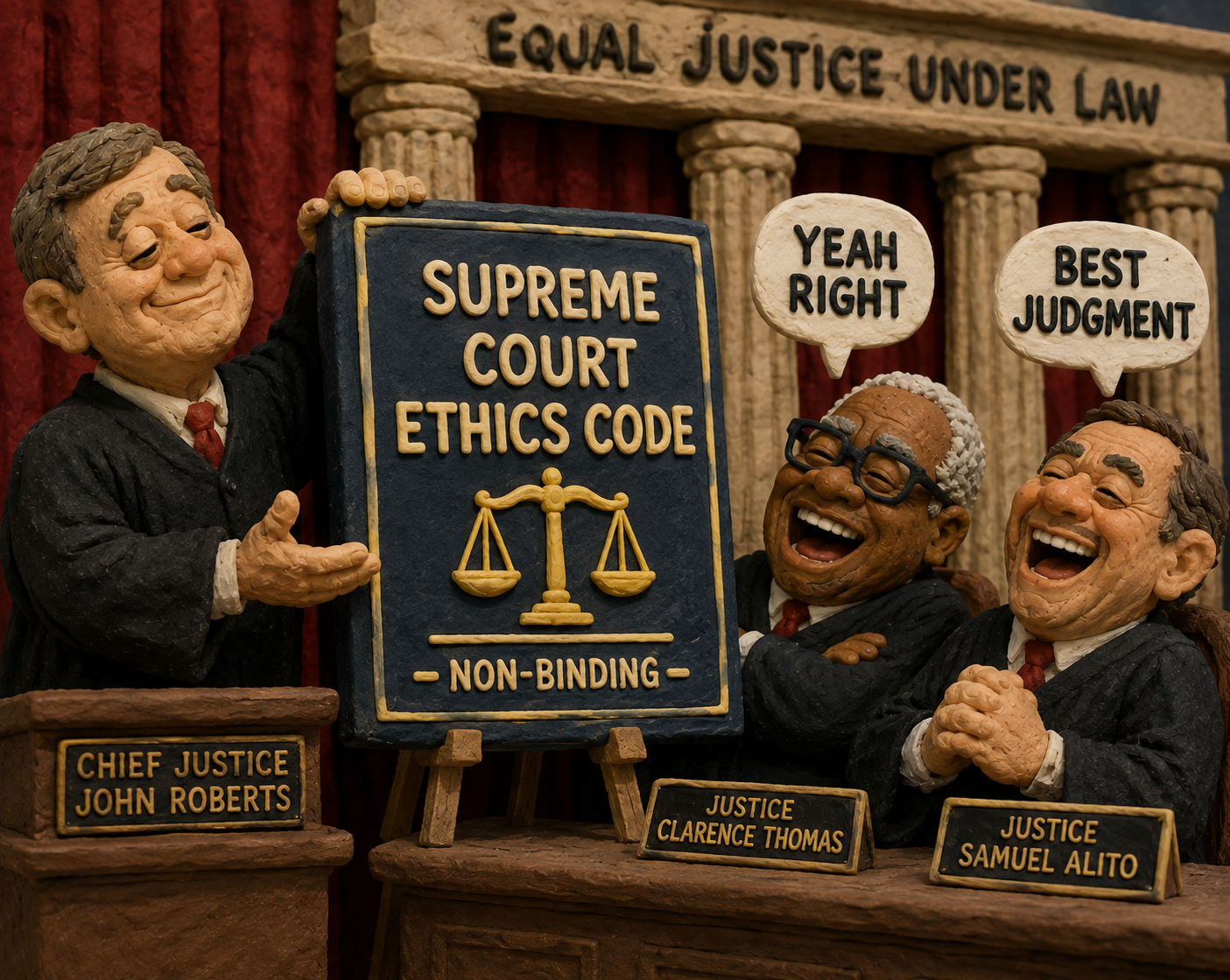
Fortas returned $20,000 and lost his seat.
Thomas received private flights, yacht vacations, tuition payments, and family real-estate benefits.
Roberts gave him an honor system.
Then there is Samuel Alito.
After an upside-down American flag associated with Trump’s stolen-election movement flew outside Alito’s home, Alito was permitted to decide for himself whether he should participate in cases involving January 6 and Trump’s claim of presidential immunity.
Alito investigated Alito, cleared Alito, and remained on the cases.
When senators asked Roberts to meet with them and address the controversy, he refused.
Effectively, Roberts sent Alito to his room. Kind of.
It wasn’t the stern parental, “Go to your room without dinner.” It was more like telling a petulant child, “Go to your room,” then leaning over as he walked away and whispering, “Don’t worry, the maid will bring your dessert later.”
Alito stayed on the cases and helped create presidential immunity.
Again, Roberts could not legally remove Alito.
But Warren could not legally remove Fortas either.
Warren understood that being chief justice meant more than counting votes and issuing statements about the Court’s greatness. It meant confronting colleagues whose conduct threatened the institution.
Roberts hides behind the formal limits of his office because moral leadership would require courage—and John Roberts has repeatedly shown that he has none.
This is why he should not be remembered merely as a bad chief justice who produced terrible decisions.
He is a terrible, terrible person.
He sold the Senate on restraint and delivered radicalism. He preached respect for precedent and repeatedly discarded it. He claimed to protect the Court while tolerating conduct that would have forced earlier justices to resign. And when handed the opportunity to decide whether a president remained subject to criminal law, he chose the president over the law.
Earl Warren believed the Court’s credibility had to be protected, even if that meant confronting one of his own friends.
John Roberts appears to believe credibility merely has to be declared—preferably by John Roberts.
History should remember him accordingly.
I’m just saying.


Comments
Post a Comment