
This is where the buck should have stopped
Those who supported Donald Trump during his first administration can offer all the familiar excuses: party loyalty, conservatism, judges, taxes, abortion, etcetera, etcetera, blah blah blah, whatever else they prefer to cite.
But January 6, 2021, was the dividing line.
And January 6 did not begin on January 6.
It began on election night, when Trump declared victory while millions of legally cast votes had yet to be counted. He announced that he wanted the voting stopped and said he would take the matter to the Supreme Court. The following morning, he made his demand even plainer: “STOP THE COUNT!” Halting the count at that moment would have left Trump ahead in several states where the remaining ballots were expected to favor Joe Biden.
Perhaps, in Trump’s pea brain, Bush v. Gore had established that the Supreme Court could simply stop an election whenever the Republican happened to be ahead. It had not. The Court stopped a disputed recount in one state. But nuance has never been an obstacle for Donald Trump, particularly when misunderstanding something serves his interests.
When the votes were counted and Trump lost, his campaign and its allies went to court again and again, asking judges to throw out votes, block certifications, and reverse the outcome. His campaign and its allies filed more than 60 lawsuits challenging the election results, and courts repeatedly rejected their efforts to overturn the outcome. Many of the judges had been appointed by Trump himself.
When the courts would not manufacture a victory for him, Trump and his team pressured Republican officials in states Biden had won. They tried to persuade governors, legislators, secretaries of state, and local election officials to disregard the voters and deliver their states to Trump anyway.
They also organized groups of fake electors in seven states Trump had lost. These people signed documents claiming to be legitimate Trump electors so their fraudulent certificates could be sent to Washington and used as an excuse to discard Biden’s valid electoral votes. This was not a spontaneous protest or a misunderstanding about election procedure. It was an organized attempt to replace the choice made by the voters with the choice demanded by the loser.
Then came the published telephone call with Georgia Secretary of State Brad Raffensperger. Trump did not ask him to investigate an uncertain number of questionable ballots. He asked him to “find 11,780 votes”—exactly one more than he needed to overturn Biden’s victory in Georgia.
The courts had failed him. State officials had resisted him. The fake-elector scheme still required Mike Pence and Congress to cooperate.
So Trump called in his supporters.
On December 19, he announced that there would be a “big protest” in Washington on January 6, the day Congress was scheduled to count the electoral votes.
“Be there,” he wrote. “Will be wild!”
That was not an invitation to attend a routine political rally. Trump focused the anger he had spent weeks manufacturing on the specific day, place, and proceeding standing between him and another term in office.
Then, on January 6, the president of the United States teed up an angry mob, aimed it at the Capitol, and singled out Mike Pence as the man standing between them and victory. When Pence refused to help Trump overturn the election, rioters stormed the Capitol searching for him and chanting, “Hang Mike Pence.”
Trump then sat in the White House dining room watching the attack unfold. For hours, he refused to call off the mob, and even attacked Pence again while the rioters were inside the building.
January 6 was not a protest that unexpectedly got out of hand. It was the final desperate move in a coordinated attempt to remain in power after losing an election.
Harry Truman kept a sign on his desk that read, “The buck stops here.” To Truman, it meant that the president is ultimately responsible for what happens on his watch. To Americans thereafter, it was a call to personal responsibility. January 6 was the moment that principle should have mattered most—and the moment it was most clearly abandoned.
This is where the buck should have stopped.
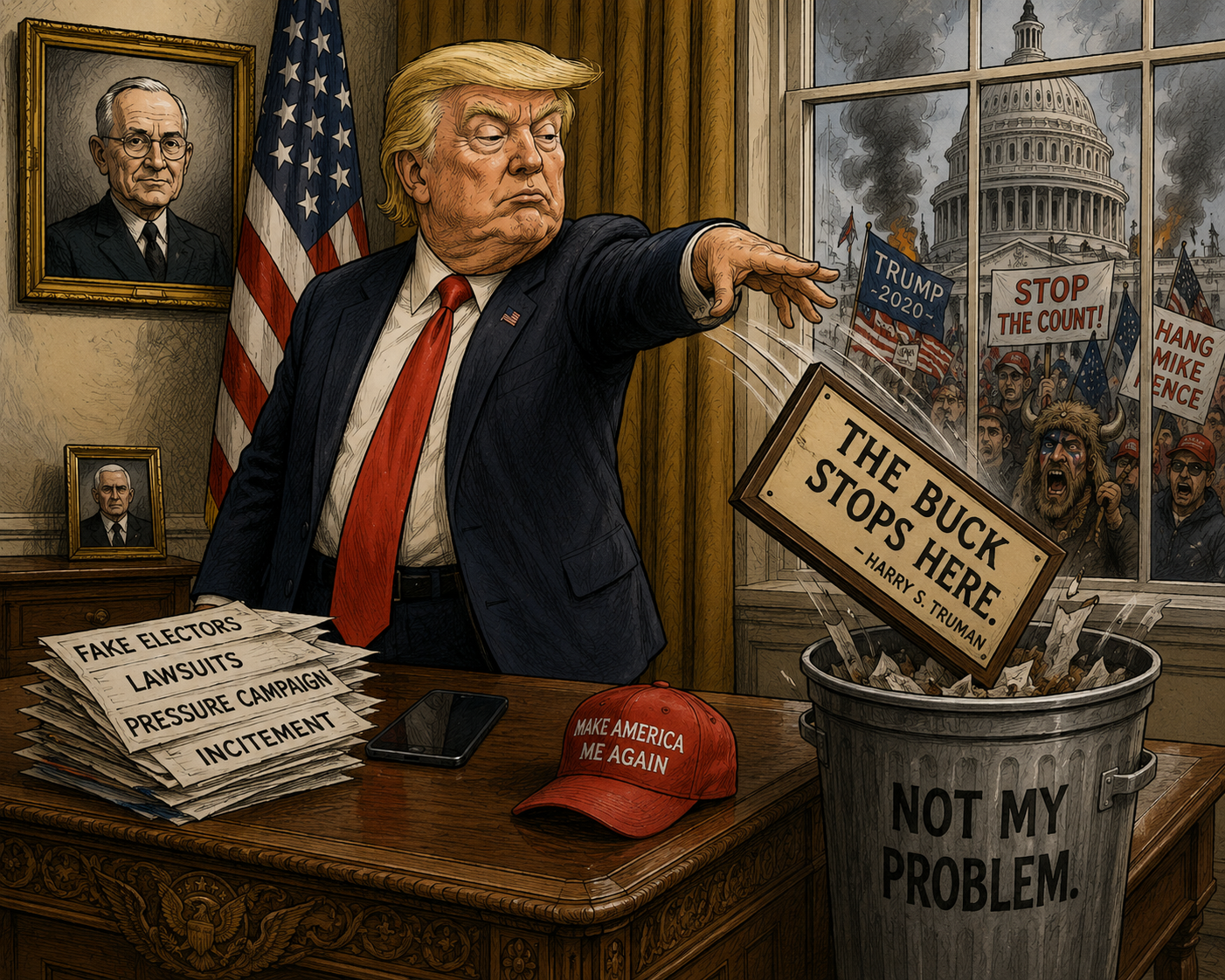
Whatever excuses people had made for Trump before January 6 should have died that day. Party loyalty, conservatism, judges, taxes, abortion: none of it could justify supporting a president who tried to overturn an election and unleashed a mob when every other scheme failed.
After January 6, there was no plausible claim that his supporters did not understand who he was, what he was willing to do, or how little the Constitution meant to him when it stood between him and power.
Continuing to support Trump after January 6 was not ordinary party loyalty. It was not conservatism. It was a conscious decision to excuse a sustained attempt to overturn an election: first through lawsuits, then through political pressure, then through fraudulent electors, and finally through intimidation and violence.
And if, four years later, you voted to return him to power, you surrendered any credible claim to being a rational, responsible American citizen.
You saw the warning. You watched the attack. You knew exactly who he was.
And you chose him anyway.
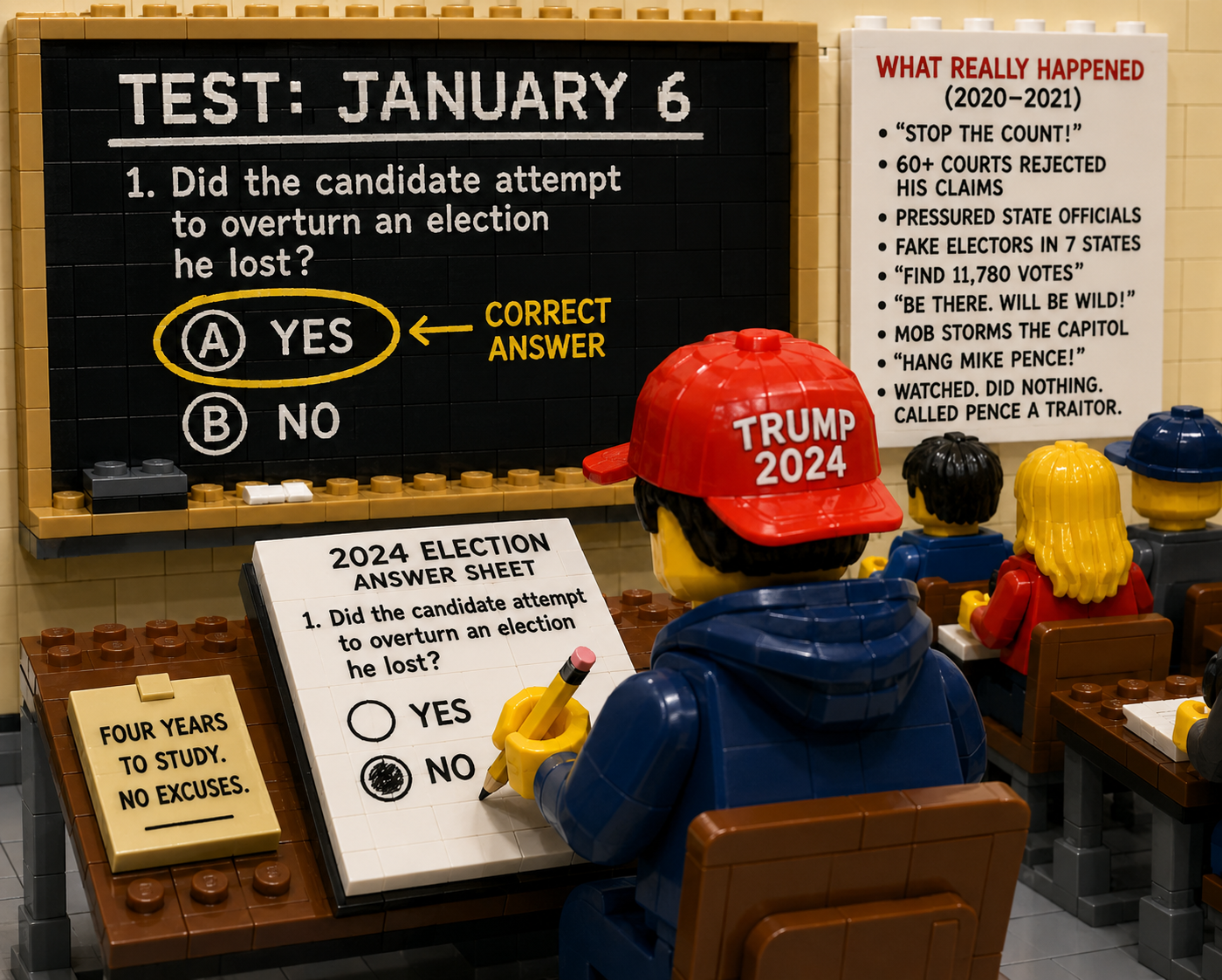
January 6 was not merely a test of Donald Trump. By then, he had already shown the country who he was.
It was a test of everyone who supported him.
It asked whether loyalty to one man mattered more than loyalty to the Constitution. It asked whether political power mattered more than truth, whether cruelty mattered more than decency, and whether winning mattered more than democracy itself.
Millions of Americans were given four years to consider that question.
Then they voted for him again.
That is what future historians will struggle to explain. Not that America once elected a corrupt, vindictive, profoundly unfit man. History is full of nations that have made terrible mistakes. The harder fact to explain will be that Americans saw exactly what he was, watched him attempt to remain in power after losing an election, and then returned him to the presidency.
Future historians will recount these years as an idiocracy—not because America accidentally elected a dangerous fool, but because millions of Americans saw the danger, understood the stakes, and chose the fool again.
January 6 was the dividing line.
The 2024 election revealed who was willing to cross it.
And no amount of flag-waving, party loyalty, or self-proclaimed patriotism can erase the choice they made once they reached the other side.
I'm just saying.


Comments
Post a Comment