
JC or DJT: You Decide
The Profession of Faith Was Optional
Donald Trump began his presidential campaign unable or unwilling to say what religion he practiced. Asked directly, he answered, “I don’t know.” A few days later, he identified himself as Presbyterian.
Then came the Bible questions. Trump called the Bible his favorite book, but when asked to name one or two favorite verses, he produced the theological equivalent of Sarah Palin’s “all of them.” He refused to name even one, insisting that his relationship with the Bible was too personal to discuss. Asked whether he preferred the Old Testament or the New Testament, he answered, “probably equal.”
A little more than a month before the Bible interview, Trump had been asked whether he had ever sought God’s forgiveness. His answer was equally revealing: “I’m not sure I have.” He explained that when he did something wrong, he simply tried to make it right himself. “I don’t bring God into that picture,” he said.
These were not obscure theological questions. They went directly to the most basic claims Trump was making about his faith. He could not clearly identify his religion, could not name a single Bible verse, could not speak meaningfully about either testament, and could not recall ever asking God for forgiveness.
Years later, having still offered no evidence of any meaningful familiarity with the book he called his favorite, Trump began selling his own-branded edition of the God Bless the USA Bible for $59.99.
This was more than a casual endorsement. Trump personally introduced the product in a sales video, directed his followers to purchase it, licensed his name and image to it, sold special editions commemorating his presidency, and offered copies bearing his signature. He presented it not merely as someone else’s Bible that he happened to recommend, but as another product in the Trump catalog.
The Bible combined the King James Version with the Declaration of Independence, the Constitution, the Bill of Rights, the Pledge of Allegiance, and the handwritten chorus of Lee Greenwood’s patriotic anthem, as though Scripture required an America-first appendix. Promoting it during Holy Week, Trump urged his followers, “Let’s Make America Pray Again.”
And yes, putting all those things in a Bible runs directly against one of the very principles it supposedly promotes: the commandment against elevating anything alongside God. It also conflicts with the constitutional principle of separating religious authority from government. No, the Constitution does not use the exact phrase “separation of church and state,” but that distinction is foundational to the system it created.
And unlike the verses he considered too personal to discuss, the proceeds were quite tangible. Trump’s 2025 financial disclosure reported that he received $1,306,035 in royalties from the Greenwood Bible.
He could not tell the country what the Bible meant to him, but he had no trouble repackaging it, branding it, selling it, and collecting the money.
Beyond questions of faith, Trump’s character presented equally obvious concerns. He had publicly described Jeffrey Epstein as a “terrific guy” and said that Epstein liked beautiful women as much as he did, adding that many of them were “on the younger side.” This was not some connection discovered years later by investigators. Trump had volunteered the assessment himself.
His own recorded words compounded those concerns. In the Access Hollywood tape—allow me to paraphrase, in keeping with the relative piety of this article—Trump boasted that celebrity gave him license to impose himself on women without consequence.
Wait, what? That's too sanitized.
He said that when you are a celebrity, you can just grab them by the p-word.
The remarks were not ambiguous or taken out of context. They were explicit, casual, and revealing of an attitude that stood in direct conflict with the moral standards many of his supporters claimed to uphold.
The religious right understood exactly what these answers and revelations meant. Its leaders heard the same answers everyone else heard. They recognized their significance and collectively decided to support him anyway.
They did not embrace Trump because they were convinced by his Christianity. They embraced him because they believed he could deliver political power, conservative judges, and victories over the people they regarded as enemies.
The profession of faith was optional. The usefulness was not.
That decision did not remain abstract. Over time, it shaped what was defended, what was ignored, and what was redefined as acceptable. The gap between professed belief and political loyalty widened, not merely in theory but in practice, revealing how far many were willing to go to preserve the advantages they had chosen.
That widening gap also exposed an uncomfortable reality: what many claimed as an expression of faith increasingly functioned as an exercise of political allegiance.
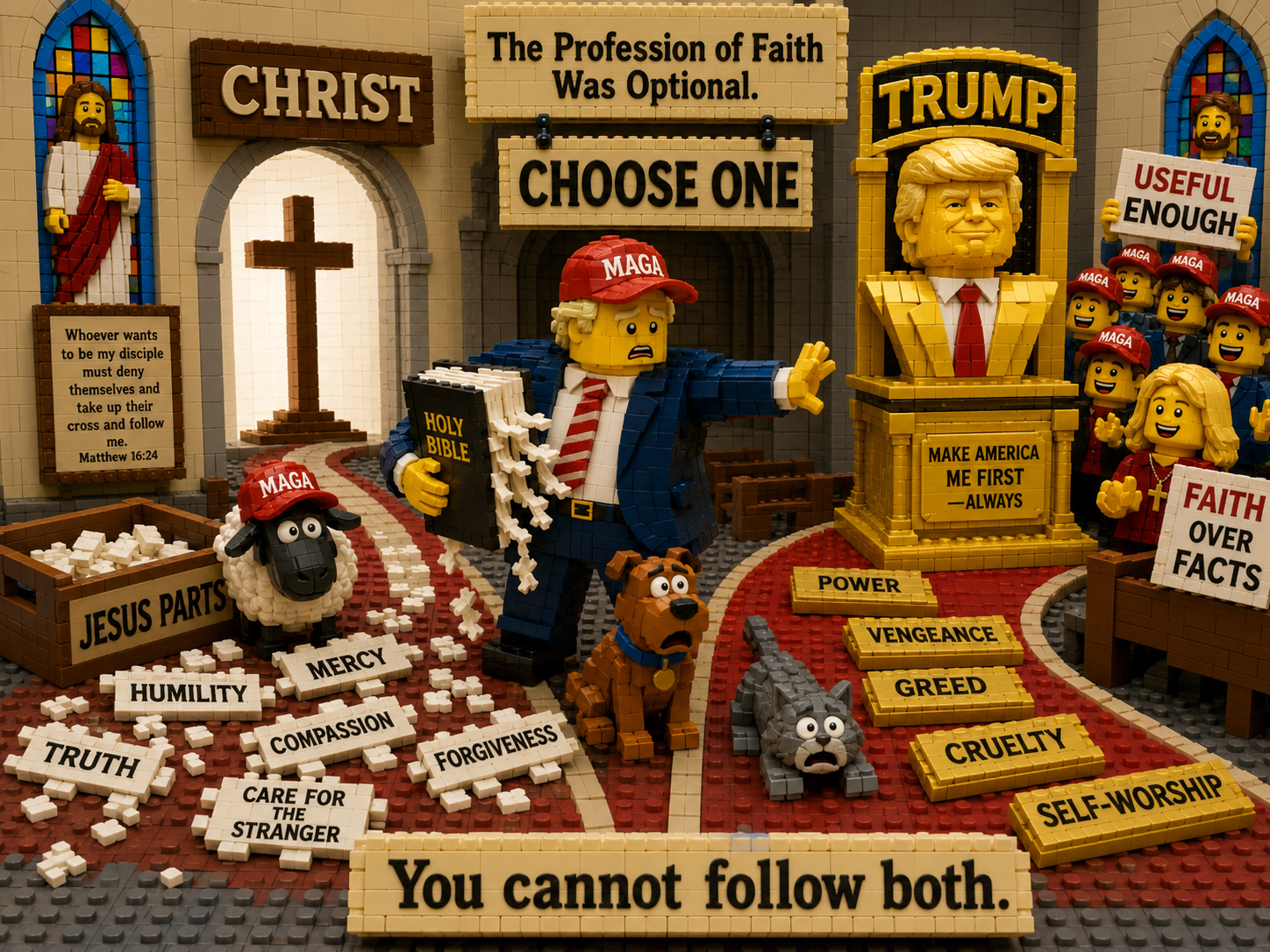
If you profess to be a Christian and still support Donald Trump, now well into his second term, then you have crossed a line that cannot be reconciled with the faith you claim. At that point, it is no longer a matter of tension or inconsistency. It is a contradiction.
You cannot claim to follow Christ while aligning yourself with a leader whose conduct consistently opposes the core teachings of human dignity, humility, mercy, truth, repentance, and love for others. To do so is not merely to fall short. It is to redefine Christianity into something unrecognizable.
Faith must mean more than showing up, singing a hymn, and repeating familiar words. It has to shape what you tolerate, whom you defend, and what kind of power you are willing to reward.
While it is true that all fall short of the glory of God, supporting Trump is not a matter of overlooking an occasional moral failure. It requires repeatedly excusing conduct that runs directly against the values Christians claim are central to their faith. In particular, it requires ignoring nearly everything Jesus taught about humility, mercy, compassion, forgiveness, care for the poor, and love for the stranger. It requires recasting cruelty as strength, greed as success, vengeance as justice, and self-worship as leadership.
The cumulative effect is not merely inconsistency. It is a transformation of what is being defended in Christianity’s name.
More plainly stated, supporting Trump requires Christians to keep the Bible while discarding the Jesus parts.
You may call yourself a Christian. You may attend church every week. You may quote Scripture and say grace before meals.
But if your loyalty to Donald Trump overrides the teachings of Christ, then the label no longer reflects reality.
You cannot follow both.
I’m just saying.


But if your loyalty to Donald Trump overrides the teachings of Christ, then the label no longer reflects reality.
ReplyDeleteYou cannot follow both. TRUTH