
When Six Words Pass for Strategy
“Iran cannot have a nuclear weapon.”
As sad as it is, that may be the only foreign-policy sentence Donald Trump can repeat without contradicting himself halfway through, slipping into the weave, or suddenly going, “Squirrel!” Maybe because it is only six words.
And for the record, I agree: Iran should not have nuclear weapons. That should not be controversial.
But Trump is not making a serious argument against nuclear weapons.
Trump and his sycophants do not oppose nuclear weapons as a category. They oppose nuclear weapons in the hands of countries they do not control, countries they do not like, countries they do not trust, and countries that do not fit neatly into Trump’s rancid racial pecking order.
Because if the argument were really “no country should have weapons capable of ending civilization,” then Russia, China, France, the United Kingdom, India, Pakistan, North Korea, Israel, and the United States would all be part of the same conversation.
And let’s stop pretending the Iran nuclear deal was some half-assed cocktail-napkin promise Obama bought with planeloads of cash, where Iran got to keep a warhead in the basement and wink at the inspectors. That is MAGA bedtime-story bullshit.
Iran did not surrender nuclear weapons. It had none to surrender.
What the agreement did was make it much harder for Iran to get one. It took away speed, secrecy, and room to maneuver. It put inspectors in the way. It put limits in the way. It put time in the way.
That was the point.
And no, the uranium people keep waving around was not a bomb in a jar. Twenty percent enriched uranium sounds scary because “twenty percent” sounds like a lot. But weapons-grade uranium is usually around ninety percent. That does not make twenty percent harmless, but it does make the panic-button version dishonest.
There is a real difference between “Iran had material that could become dangerous if pushed much further” and “Iran had nuclear weapons.” The first is why the agreement existed. The second is just fear dressed up as fact.
And everyone serious who was actually watching the agreement understood that it was working. The inspectors understood it. The other signatories understood it. Even Trump’s own national security apparatus could not honestly claim Iran was violating the deal before Trump decided to rip it up.
Which leaves the conclusion sitting there in broad daylight: Trump ended the agreement because the Black guy did it.
Not because it failed. Not because he had something stronger ready. Not because there was some urgent national-security necessity.
He ended it because Obama built it, and Trump’s political project has always been rooted in grievance, resentment, and the destruction of anything that made Barack Obama look competent.
And then his war whisperer, Benjamin Netanyahu, stepped in. Trump mistook another man’s bloodlust for strategy.
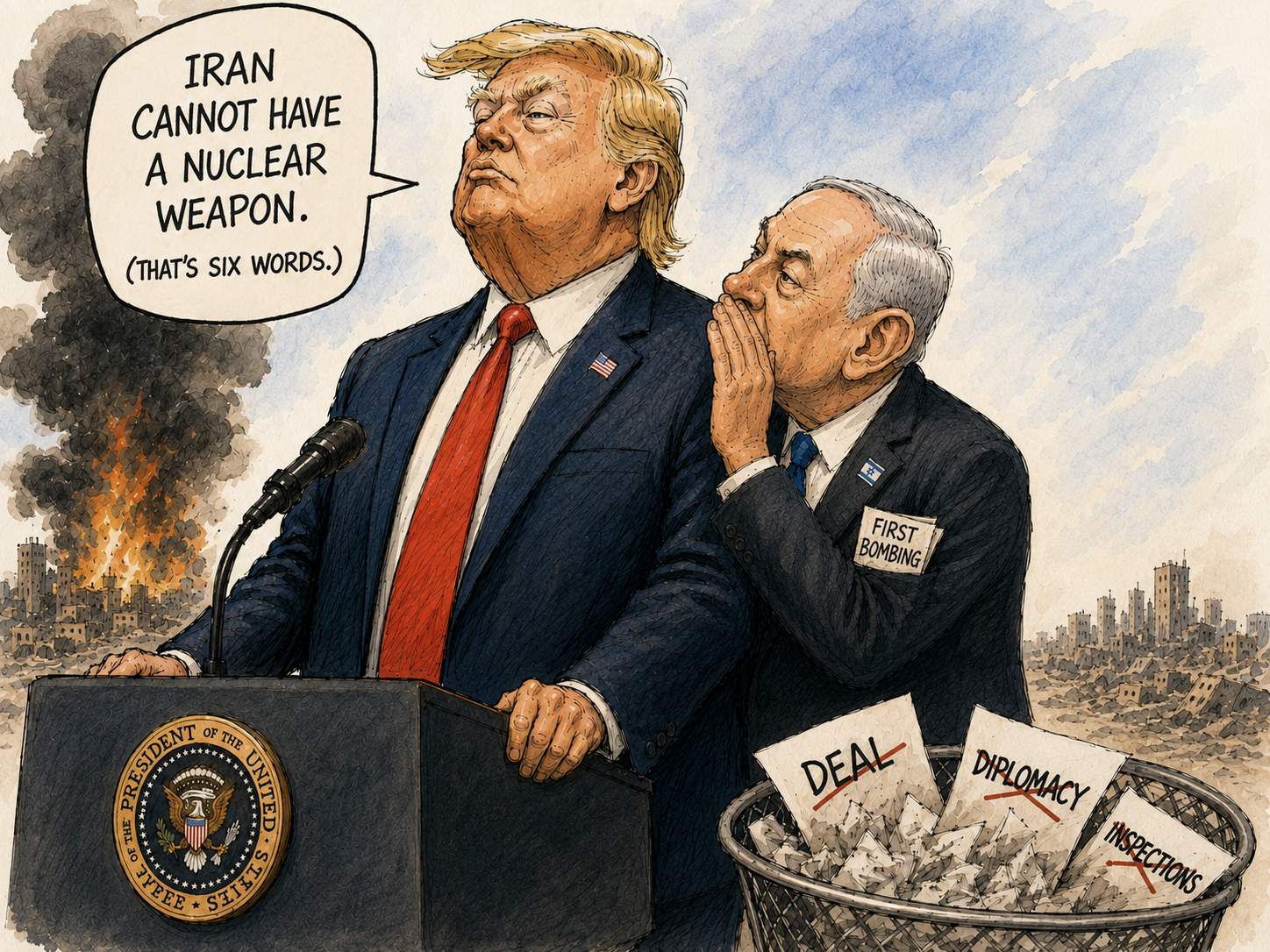
After the bunker-buster strikes, Trump told the country that Iran’s nuclear facilities had been completely and totally obliterated. And to be clear, the progression is: damaged, depleted, decimated, crippled, devastated, ravaged, gutted, shattered, obliterated, annihilated, eradicated, extinct.
He did not say damaged. He did not say degraded. He did not say set back.
He went with obliterated.
Meaning the program was gone. The threat was handled. Mission accomplished, only this time, somehow, delivered with worse syntax, a smaller vocabulary, and worse articulation.
But months later, here he was again, warning that Iran had miraculously reconstituted its nuclear program and was somehow seconds shy of doomsday.
Wait, what? If the first attack obliterated Iran’s nuclear capability, how did the corpse get up, dust itself off, and start sprinting toward DC?
And if the first attack did not obliterate Iran’s nuclear capability, then the first words out of his mouth should have been: “America, I was wrong.” Not “Trust me,” not “More bombs,” and definitely not another round of “Iran cannot have a nuclear weapon,” as if repeating the same six words louder counts as foreign policy. He should have said, “I was wrong. I told you the last attack solved this. It did not.” But he cannot say that, because accountability is not a weapon in his wheelhouse.
Either the bombs worked, or they did not. Either the deal he destroyed mattered, or it did not. Either Iran’s program was eliminated, or he lied when he said it was.
But he does not get to keep three versions of the truth in his pocket and pull out whichever one makes him look least guilty.
And since “Iran cannot have a nuclear weapon” is apparently his whole rallying cry, maybe he should state for the racist little record exactly who he thinks should have one.
Because I’ll bet dollars to donuts there are no “shithole countries” on that list.
The only country on Earth that has ever used nuclear weapons in war is the United States, the country Donald Trump now leads.
That does not mean Iran should have one. Of course Iran should not have one. But it does mean America should speak with at least some memory of its own history before strutting onto the world stage like the referee of civilization.
We are not the country that merely warned the world about nuclear horror; we are the country that introduced it.
And once one nation proved it could erase cities, everyone else with enough fear, money, ambition, paranoia, or technical capacity started doing the math.
Different paths. Same lesson.
The bomb does not stay owned by the first country arrogant enough to use it.
So no, Iran should not have nuclear weapons.
But Donald Trump does not get to break the agreement that restrained Iran, brag that bombs erased the danger, then use the same danger as proof that he needs more bombs.
He does not get to pretend America has no nuclear history.
He does not get to pretend his hierarchy is morality.
And he does not get to keep shouting “Iran cannot have a nuclear weapon” as if the words become wiser each time he says them into a camera.
I'm just saying.


Comments
Post a Comment