
The Tulsi Two-Step
It was quietly announced in late May that Tulsi Gabbard would be stepping down as Director of National Intelligence.
Almost immediately, Bill Pulte was named as Trump’s choice to take over in an acting capacity. That should have been its own scandal. When the position of DNI was created, the law said the person nominated for the job “shall have extensive national security expertise.”
Pulte had almost none.
But Trump does not care about that, because Trump’s singular qualification for any position is blind fealty to Trump. Not experience. Not judgment. Not competence. Not even a passing acquaintance with the job description.
Loyalty.
And because Republicans control the Senate, and Trump still holds most Republican senators by the short hairs, he had little reason to fear serious resistance. If he tells them a man with no intelligence background belongs atop the American intelligence community, most of them will nod, swallow hard, and pretend the law is more of a decorative suggestion.
But then Trump saw Jay Clayton on CNBC echoing his California election-fraud malarkey, saying Americans were “right to question” election integrity and that California’s mail-ballot rules created an “opportunity for fraud.”
Bingo.
For some reason, that apparently said “Director of National Intelligence” to Trump, even though he already had a candidate on deck.
And those aforementioned qualifications?
Nope. Clayton did not have them either.
But he had said the magic words. He had taken Trump’s election-fraud nonsense, dressed it up in a suit, and said it on television. In Trumpworld, that is not a red flag. That is a résumé.
So, on June 11, 2026, Trump announced Clayton’s nomination for DNI.
Less than one week later, Trump blew up his own nominee’s hearing. He claimed “we” were canceling the Senate hearing, as if the Senate Intelligence Committee were just another prop department at Mar-a-Lago. In reality, the hearing was derailed after Trump put the nomination on hold and directed Clayton not to appear.
And why?
Because Trump tied the whole thing to Clayton’s replacement as U.S. Attorney, FISA, and the SAVE America Act, a voter-ID bill even Trump had to know was dead in the water.
So Clayton was nominated, then stalled. Pulte was unacceptable, then preserved. Gabbard was leaving, then leaving sooner.
But here is the thing: the reason for this entire dog-and-pony show was not personnel management.
The resignation announcement. The original departure date. The accelerated departure date. The on-again, off-again musical chairs with replacements.
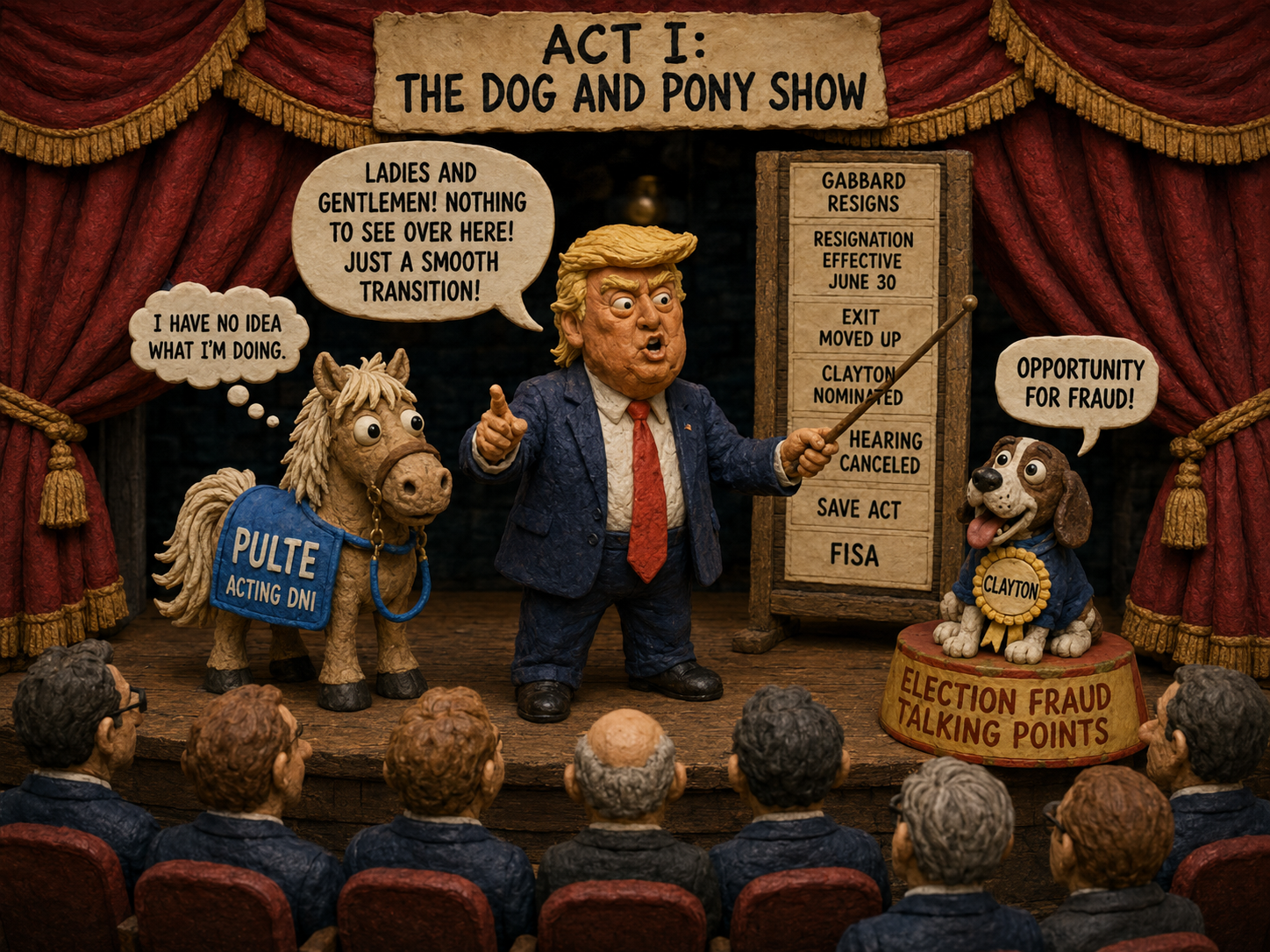
They were trying to outrun a news story.
And not a small one.
The Washington Post reported that it reviewed more than 25,000 pages of material from Rebecca Saltzburg, a former Science of Identity Foundation member and Gabbard campaign worker, including hundreds of confidential memos from Gabbard’s years in Congress. Many were reportedly connected to a private email domain Saltzburg said was used by Chris Butler’s office.
According to the Post, those memos allegedly offered political guidance: legislation, policy positions, television answers, and media performance.
That is not a quirky footnote.
That is a question of autonomy.
The issue is not her religion. The issue is whether a member of Congress, and later the Director of National Intelligence, was shaped by an undisclosed private influence network operating outside public view and democratic accountability.
The Post also reported that Gabbard’s public actions sometimes tracked the memos, including an ISIS-related memo followed by a statement and bill.
It also reported an online operation involving fake or pseudonymous accounts, bogus profiles, coordinated commenting, and suggested language meant to make manufactured support look organic.
That matters.
The Director of National Intelligence is supposed to help the country tell the difference between reality and manipulation. If the reporting is accurate, Gabbard’s own political rise was surrounded by exactly the kind of hidden influence and artificial amplification the intelligence world is supposed to recognize as a threat.
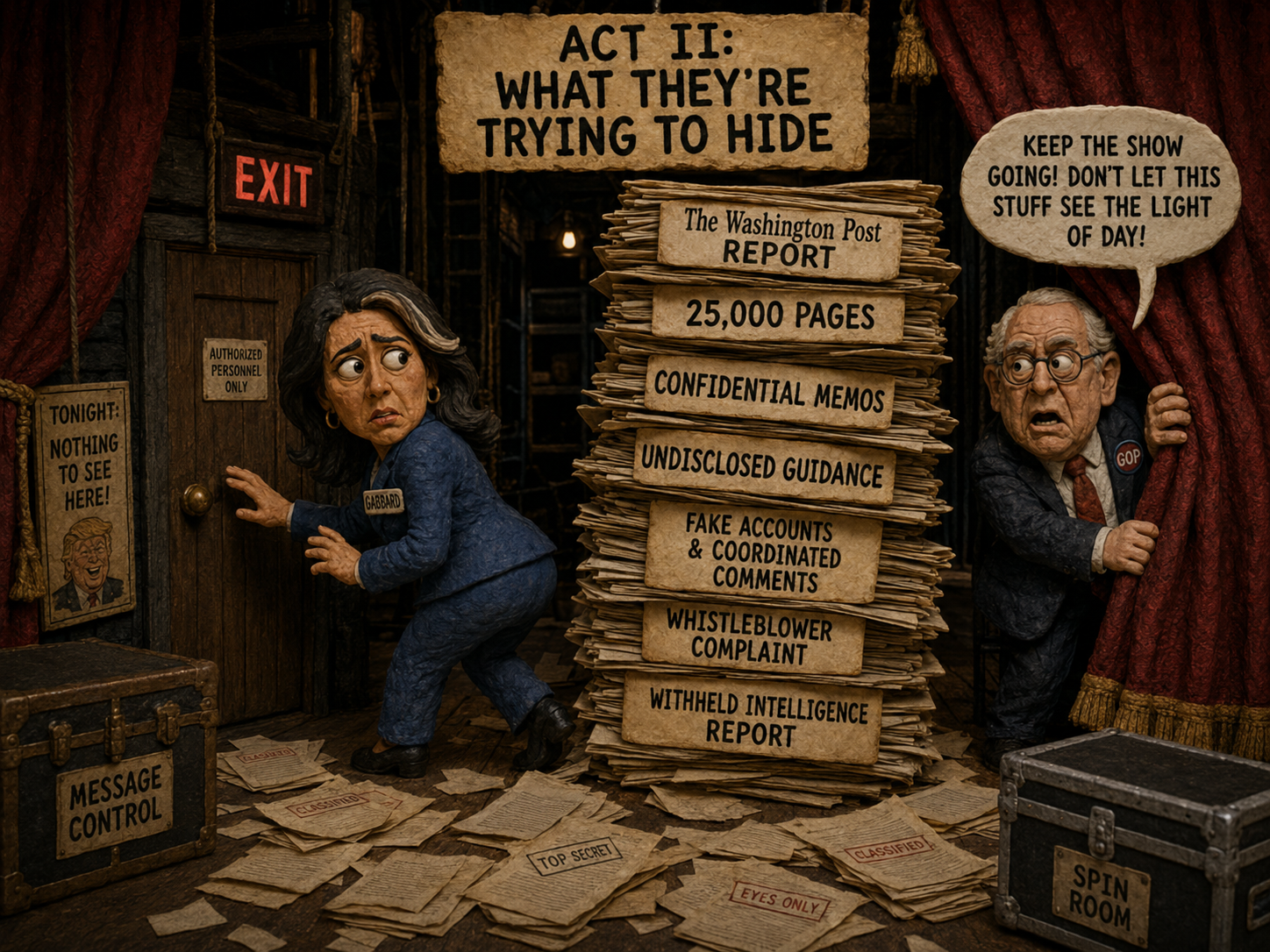
And these concerns do not stop with old campaign behavior. While serving as DNI, Gabbard’s office was also accused by senior congressional Democrats of mishandling an urgent whistleblower complaint and withholding an underlying intelligence report from congressional oversight under an executive privilege claim they called unprecedented.
So the question is not just why Gabbard left.
The question is what the White House knew, when it knew it, and why it seemed so determined to get her out the door before the Post story made the answer harder to dodge.
The real story is how Tulsi Gabbard got the job in the first place, what the White House knew when it moved her out, and why the Republican senators who confirmed her are not being forced to answer for it now.
Because let’s not pretend she snuck into the intelligence community through an unlocked side door.
Republicans confirmed her.
They were warned. They heard the concerns. They saw the record. They waved it away. They treated objections to her judgment as partisan hysteria. They handed the keys to the American intelligence community to a woman whose fitness for that role had been questioned for years.
Now, with this new reporting, the question for those senators should be simple:
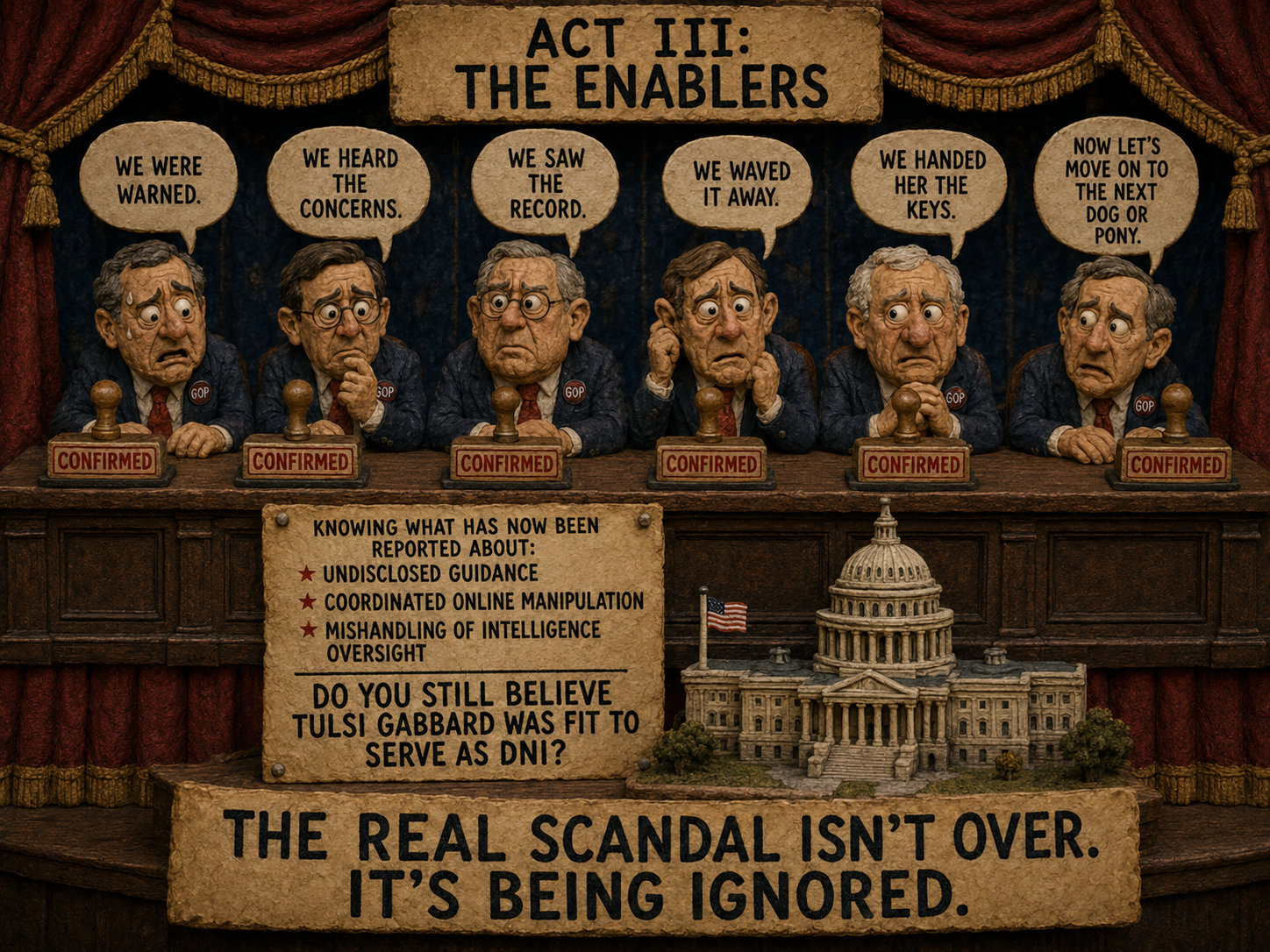
Do you still stand by that vote?
The question is:
Knowing what has now been reported about undisclosed political guidance, coordinated online manipulation, and Gabbard’s handling of intelligence oversight, do you still believe Tulsi Gabbard was fit to serve as Director of National Intelligence?
That is the question the press should be asking every Republican who voted yes.
Because the issue is not merely that Trump nominated her. Trump nominates chaos the way other men order fries.
The issue is that nearly every Republican senator looked at Tulsi Gabbard, looked at the known warnings, looked at the stakes, and said:
Yes. Put her in charge.
And now that new allegations have made the old warnings look less like paranoia and more like the blinking lights on an ignored dashboard, those Republicans would very much like the conversation to move on.
Of course they would.
That is why the White House dance matters.
It turns a scandal about judgment, influence, intelligence, secrecy, and Republican complicity into a staffing story.
But the Tulsi story is the story.
Not because every allegation has already been proven in a courtroom.
Not because anyone should casually call her a spy without evidence.
But because the person who held America’s most sensitive intelligence position is now the subject of reporting that raises exactly the kinds of questions that should have disqualified her from that role in the first place.
I’m just saying.


Comments
Post a Comment