
Statical Pink Noise
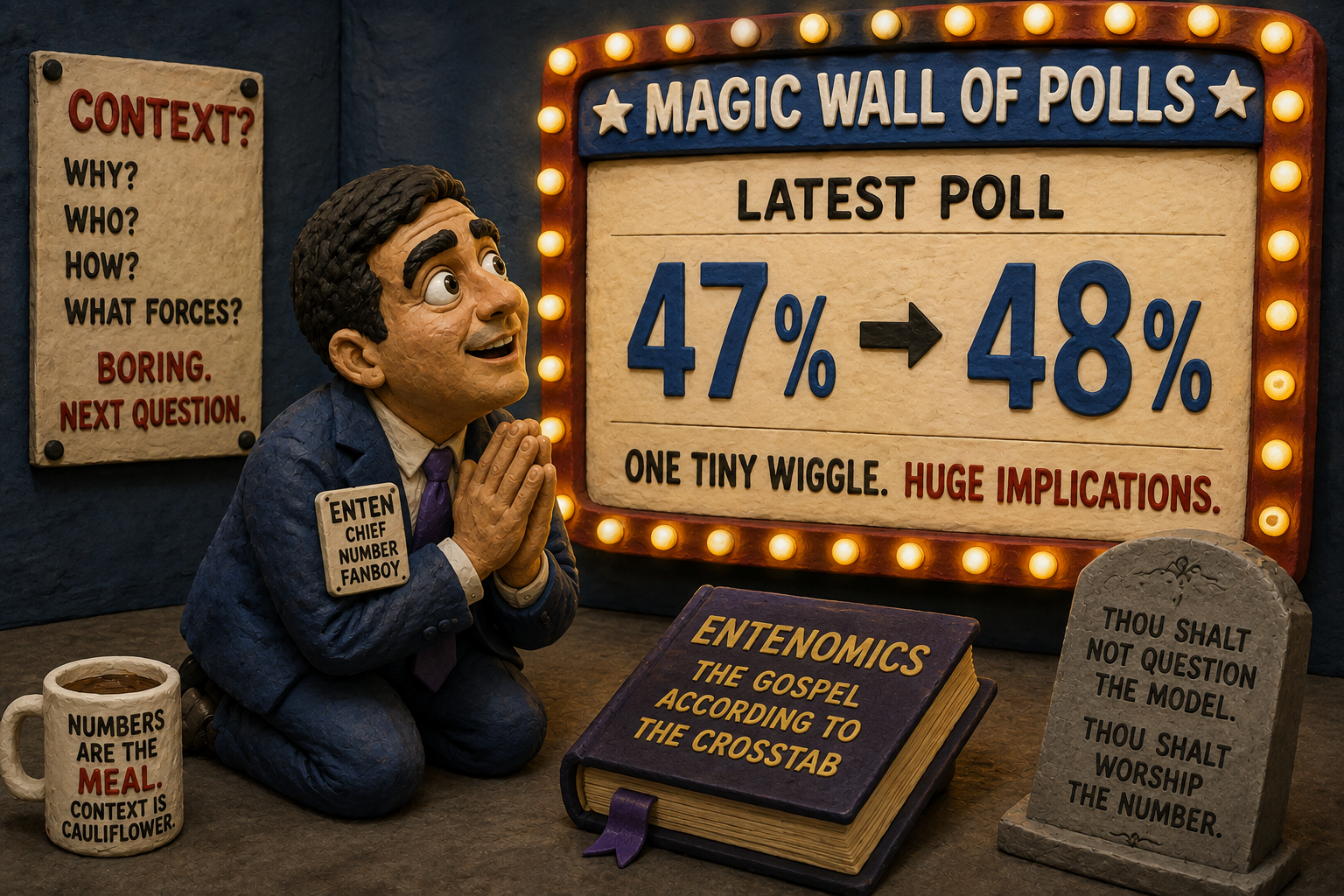
He’s concerned almost entirely with the numbers, not what they represent, why they reflect what they reflect, or what forces shaped them in the first place. To him, the number is the meal. Context is just cauliflower pushed to the edge of the plate.
And this isn’t new. He was just as excited about poll numbers before the 2024 election, when the spread was usually two points at most and often much smaller. Once you factored in the margin of error, half of what he was breathlessly analyzing wasn’t movement at all. It was statistical pink noise.
There he stood in front of his magic wall, treating every tiny fluctuation inside the margin of error like democracy had just handed him a notarized confession.
That’s the problem with so much political polling coverage. The number goes up. The number goes down. One candidate gains a point. Another loses two. Suddenly, we’re supposed to act as though the soul of America has been revealed through a crosstab.
But numbers don’t explain themselves.
They’re symptoms. They reflect fear, media framing, turnout assumptions, voter suppression, racial backlash, economic anxiety, propaganda, exhaustion, and whatever else is moving beneath the country at the time. A poll number tells you something happened. It doesn’t automatically tell you why it happened, whether it matters, or whether the people being polled reflect the electorate in any meaningful way.
Viewers almost never get enough information about how those polls were assembled. Which polls are being followed? Who commissioned them? How many people were sampled? Were they adults, registered voters, or likely voters? What were the racial, age, gender, education, income, and geographic breakdowns? How were the results weighted? What was the margin of error? What assumptions were baked in before the number ever reached the screen?
Without that context, a poll number isn’t analysis. It’s a weather report without radar or barometric pressure, delivered by a weatherman you don’t recognize.
And, by the way, “likely voters” is its own little kingdom of bullshit.
The phrase lets a pollster interview someone, record the answer, and then quietly decide whether that person counts enough to matter. If the respondent isn’t likely to vote, fine—but then why the fuck did you interview them? And if you did interview them, why does their opinion become disposable because your model says they’re less likely to show up?
Maybe there’s a legitimate methodology behind it. Maybe. But then show us. Tell us what questions were asked. Tell us who got screened out. Tell us how many people moved from “respondent” to “irrelevant” because some formula decided they weren’t wearing the proper shoes for democracy.
The deeper problem is that the polls themselves are often weak, uninformative, unimaginative, and built around bald-headed horse-race questions:
Who are you voting for?
Do you approve or disapprove?
Is the country on the right track or the wrong track?
Ask those questions. Just don’t pretend they explain anything.
Where are the questions about why people believe what they believe? Where are the questions about what media they consume, what stories they’ve absorbed, what fears are driving them, what lies they’ve mistaken for facts, which policies they actually understand, and what they’re merely reacting to because somebody on television told them to be angry?
A poll showing a candidate up two points doesn’t tell me whether the movement came from persuasion, panic, propaganda, turnout assumptions, bad sampling, or, again, statistical pink noise.
Polling coverage keeps pretending the number is the story. It isn’t. The number is the footprint. The story is whatever walked through the mud before the cameras showed up.
A two-point spread isn’t a revelation. A one-point movement isn’t a national mood swing. A likely-voter screen isn’t the voice of God.
It’s a model. It’s an assumption. It’s a choice.
And if you’re going to put that choice on television and call it analysis, show your work.
Or here’s a wild idea: report what everybody you interviewed said, not just the ones wearing espadrilles.
If you talked to registered voters, tell us what registered voters said. If you talked to adults, tell us what adults said. Then, if you want to wave your little likely-voter Ouija board over the results afterward, fine—but show us both numbers. Don’t interview the whole room and then introduce us only to the people your model has decided actually count.
That’s what makes Enten’s whole schtick so exhausting. He doesn’t analyze polls so much as fondle them. The number rises. The number falls. The trend line wiggles. The crosstab breathes. And there he is, practically vibrating because somebody whispered “suburban white women with college degrees” into his earpiece.
He’s drooling. He’s almost stuttering. It kind of sounds like he may have peed a little.
If CNN gave him enough airtime, he’d probably recite pi to 1,500 digits and call the 1,347th digit a troubling trend for Democrats.
The problem isn’t that numbers are useless. Numbers matter. Polls matter. Data matters. But data without context isn’t journalism. It’s theater. It’s network-sponsored Whac-A-Mole, where every tiny polling fluctuation gets smacked with a mallet and called analysis.
Political polling should help explain the country. Instead, it too often becomes a scoreboard for people who’d rather track the horse race than explain why the horses are running, who owns the track, who got locked outside the gate, and why the announcer keeps pretending the whole thing is objective.
The number isn’t the story. It’s a clue.
And if you’re going to put it on television, surround it with flashing graphics, and call it analysis, you’d better tell us what it means, how you got it, and what choices were made along the way.
Otherwise, it’s just Harry Enten standing in front of a glowing wall, announcing that the latest statistical burp has fundamentally altered the republic.
I’m just saying.


Comments
Post a Comment